
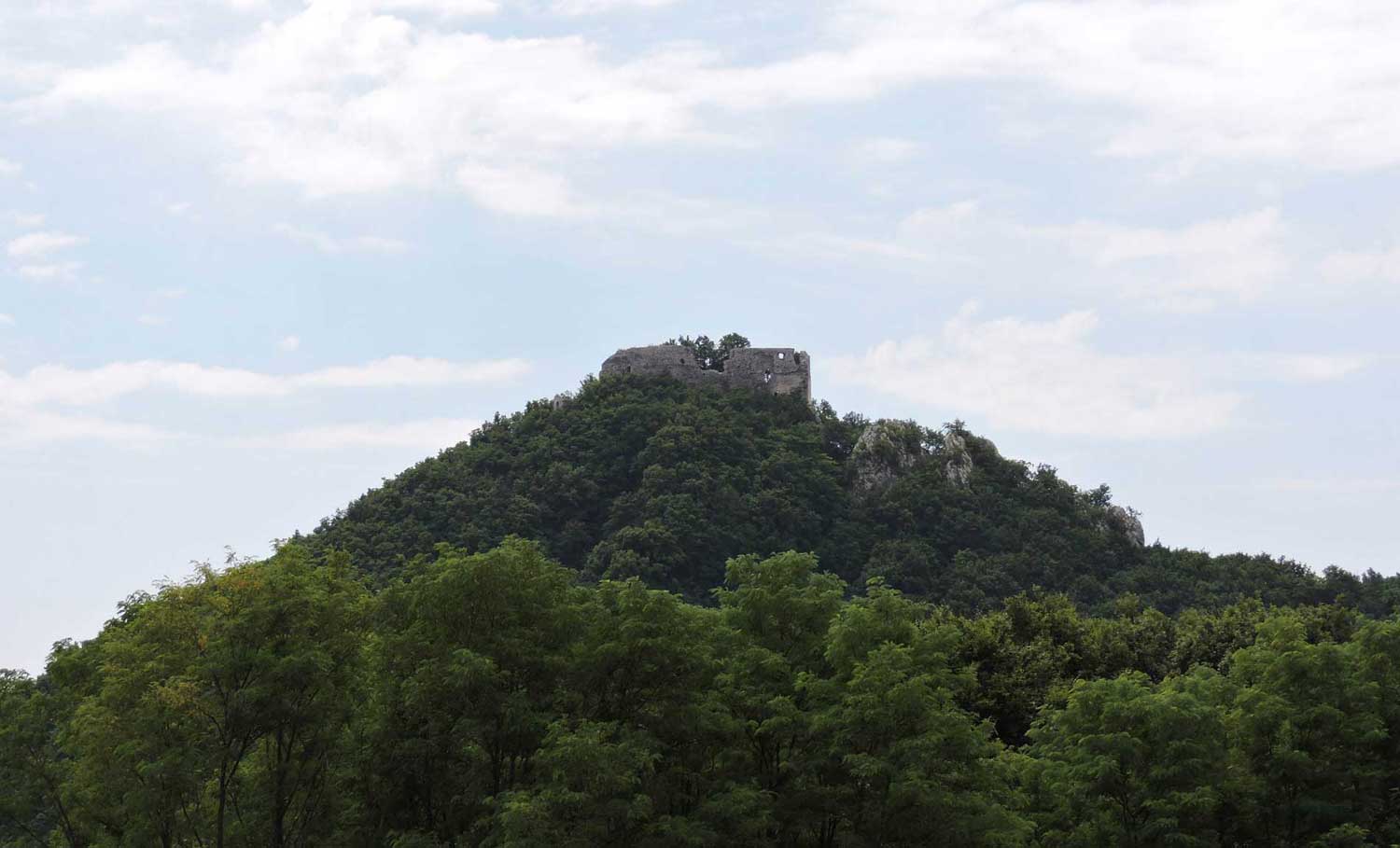
To speak of Okić without mentioning Dragojla Jarnević would be irresponsible and, at the very least, unjust — for she was the first woman to climb Okić from the south, its steeper side. Even by today's standards this is a considerable feat; in her time there was no climbing equipment, and she made her way up the steep, jagged rocks barefoot! The path on the southern side leading up to Okić is today marked as "Dragojla's Trail" and is well known to climbers, sport climbers, hikers and other visitors to Okić.
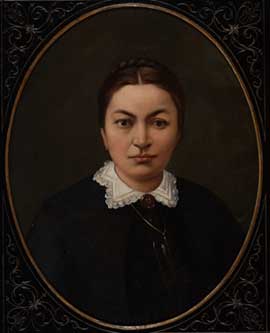
The Illyrian writer Dragojla Jarnević (Karlovac, 4 January 1812 – 12 March 1875), who had written exclusively in German until 1839, began her prolific literary career in the Croatian language under the influence of Ivan Trnski and other collaborators of Ljudevit Gaj, signing her work as "an Illyrian woman from Karlovac." She left behind a substantial diary running to more than a thousand pages, published in 1958 by Stanko Dvoržak under the title The Life of a Woman. In 2000 the Croatian writer, translator and scholar Irena Lukšić published the complete, unabridged edition of the diary. From it I take the passage describing the parish fair below Okić Castle, followed immediately by her own account of her ascent to the ruins.
"...Last night I returned late from below Okić, where every year, on what is called Kljukovska Sunday, a pilgrimage is held at the local shrine of Our Lady, followed the next day by a great fair. A great multitude of people had gathered there, and I could not gaze my fill at the variety of sights spread across that open space. At ten o'clock in the evening I arrived at an inn for a night's lodging, having come there for just that purpose, and I passed the greater part of the night most agreeably among the simple country folk who had assembled there and settled down on the hay in the haylofts and drying sheds. Merry, as was my disposition, I busied myself greatly with the young wives and their husbands, danced and leapt and sang with them; I let them all embrace and hug me; let them kiss me and one after another call out to me: "Oh, our dear lady, how merry and kind they are, how nicely they play with us, and how they are not in the least bit proud!"
I had never before set eyes on any of them, yet in that very first moment I had at once won the hearts of all. They knew they had among themselves certain so-called free-spirited souls, and it pleased them that townsfolk did not hesitate to join their circle on equal terms. Warmly, yet without overstepping the bounds of propriety, the young men made merry with me, and many a cup I was obliged to raise to my lips in order to drink a toast with them..."
In Dragojla Jarnević one can clearly sense a deeply felt Croatian patriotism, as well as an awareness of the poor education and harsh treatment endured by the Croatian people at the hands of the nobility. She goes on to describe an episode that arose during the festivities, writing:
"One Slovak in particular delighted me greatly, who cried out together with me, after the musicians had been about to strike up some sort of Hungarian dance on their fiddles: 'We will not have you play us that Hungarian gypsy dance; we are Slavs and we will have you play in our fashion; play us something Croatian; to the devil with their Hungarian mother! We shall have it our way!'
His frankness pleased me, and I cried out: 'Long live the Slovak! We are brothers! Give us another cup of wine, innkeeper!' Education for our people and more humane treatment on the part of the nobility towards them, and 'a happy Croatia!' in every respect — these are the things we might cry out for."
Dragojla Jarnević was thirty-one years old at the time. Her candid narrative also bears witness to the wonderful people of the Okić, Plešivica and Samobor area, who have always known how to offer warmth and hospitality to all who respected them — a quality that endures to this day. S. Dvoržak is therefore quite right when he comments on this passage from her diary by adding:
"These episodes, rounded off by a bold ascent to the very ruins, reveal Dragojla's democratic spirit and courage — qualities that not every man of her time could boast of..."
But what, one may ask, is this ascent and which ruin does Dvoržak refer to, yet does not describe in his book about Dragojla Jarnević? She set out from Karlovac on 10 September 1843, knowing that the village of Okić was five hours' journey away (by the standards of the time) and that there stood "on the high summit of an inaccessible crag an ancient ruin." She had most likely caught sight of Okić many times from Karlovac — no rare occurrence in the pre-industrial age. She was eager to "reach the ruin, if I can find suitable company with whom I might climb up there."
Her ascent is connected with an ancient religious and folk custom of the Okić area: the pilgrimage held on the feast of the Small Lady (the Nativity of the Virgin) or on the Sunday following, known as the Kljuka or Ključko pilgrimage — or, as Dragojla calls it, Kljukovska Sunday — and the fair held the day after. She came with her brother-in-law (her sister's husband) and her sister, who had a stall at the "market" selling their "wares." The location in question was a space known as "the Plac," on which, after the tragedy of the village of Popov Dol, a new village was built called Okićka Sveta Marija, later renamed by the communist authorities to its present name, Novo Selo Okićko.
We may surmise that she walked along the forest track that winds from Popov Dol to the foot of Okić on the southern side. Together with her companion — an acquaintance from Karlovac whom she had encountered at the pilgrimage and who had come to Okić with the same purpose in mind — she first caught sight of the southern rock face of Okić, which is at its highest on that side and, along with the western ridge between the present-day mountain hut and the fortress ruins, its most picturesque. A secured climbing route was laid along one of the ribs of the southern rock face in 1980.
They did not look for paths to the ruins, for there were none; and the remains were exactly as the passage of time had shaped them following the final abandonment of the fortress before 1619. By all accounts, Dragojla set off with great enthusiasm and determination from the foot of the southern slope of Okić — from the stony bed of the stream Okićnica — heading straight upwards, most likely between the middle and eastern rocky ribs on that southern face. In the lower section they climbed through overgrown rocky terrain, and in the upper section between the rock faces (a fissure between two rocks was overcome with the help of a felled tree trunk) and over scree strewn with stones fallen from the walls.
It was a true mountaineering experience — the satisfaction of testing one's own character against the difficulties that nature presents, followed by the reward: a successful ascent and the pleasure of a wide, sweeping view. To that was added the delight of a companionable, and by the standards of the time quite unconventional, relationship between a man and a woman.
Dragojla Jarnević was a passionate lover of nature; her homeland was her eternal love, and she strove to know it as fully as she could. She was particularly drawn to the hills of Japetić and Plešivica, and she is well known in mountaineering literature as a climber who also describes her own alpine feat — namely, "crawling" up the sheer, inaccessible rock faces of the steep Okić. Here is how she describes her expedition to Okić, undertaken on 11 September 1843:
"...The following day I went out alone, since my brother-in-law and sister, with whom I had arrived, remained under the awning tending their stall at the fairground, and by great good fortune I chanced to meet an acquaintance, a citizen of Karlovac, who had come there with the same intention as myself — to look around the fair and the surrounding countryside, which neither of us had ever had occasion to see before; and having quickly come to an understanding, we set off towards the ruins of Okić, which lie somewhat more than half an hour's walk from the fairground.
When the two of us reached the foot of the crag, which rose steeply upward, it seemed to my companion that reaching the ruins was quite beyond his powers; but my desire to look out over Croatia from that height drove me to make possible what had seemed impossible, and I set off into the thickets in search of a path; seeing how resolutely I pressed forward, heedless of thorns or stones, my companion let himself follow me, for he was ashamed that a young woman should show more heart than he.
Between the trees we had managed to wriggle our way along quite well and had very nearly reached the ruins themselves; but there, all at once, our progress was suddenly barred — a chasm opened before us, making it impossible for me to go any further. Yet the desire to reach the walls of the ruin blazed in my eyes and in my words, and my companion, seeing my determination and resolve, found a way. Discovering a stout log nearby, he laid it across the chasm and led me safely to the other side.
But now we encountered fresh obstacles. The fearfully steep and slippery path over the rocks and tumbled ruins was fraught with danger, and to crawl along it was to risk one's neck; yet my desire to reach the summit made me scorn every peril. I removed my shoes, tucked my clothing tightly about me, and set off scrambling upwards like a cat — now clinging to the roots that burst from the rock face, now to the tips of oak branches, now to the crags themselves. My companion, watching me climb in this fashion, stopped in amazement and said:
"Miss! as God is my witness and on my honour! I cannot help but admire you. I have been a soldier and have taken many a treacherous path in my time, but never one such as this — and nothing on earth would have brought me here now, were it not for you. Yet I will not let myself be shamed by you, and if you tumble headlong, I will gladly perish with you, proof enough of how much courage and resolve you possess! Why, you would not find one girl or woman in a thousand who would scramble through such a place at such peril, though you would find no shortage of men who would not dream of risking their necks here."
Yet the jest pleased me, and we crawled and hauled ourselves to the top without mishap. The toil of the ascent was more than repaid by the view of the countryside spread around us — far across Zagorje to the Styrian hills, across Karlovac, Zagreb, and away down into Slavonia!..."
Having climbed to Okić and savoured the sweeping view into the distance, the time came to return the way they had come. If the ascent had been no easy matter, the descent was certainly no less demanding — most likely by the same route — and Dragojla goes on to write:
"...On the wall my companion looked down at the fearful depth and steepness before us and said to me: 'Miss! I shall fear for you on the way back down; going down will be far harder than going up; though I am a man, I could do nothing to help you if your foot were to slip even slightly, for we should plunge headlong with no hope of saving ourselves.' 'Oh, have no fear!' I replied. 'I am not afraid of anything, and with God's help we shall reach the bottom again safely.'"
Holding on above at the treetops, he lowered me down in places; then in other places he pulled me down towards him, as the terrain allowed, and so we arrived safely at the bottom once more. 'No, no! This is something unheard of in a girl!' he cried out twenty times over. 'Every man alive should bow before your resolve and your courage; upon my soul! I would not for anything in the world have undertaken this neck-breaking path alone — yet I could not let myself be put to shame by you!'
And indeed, once we had stopped and rested below, and I looked back up at those crags, a shiver ran down my spine, and the thought of the precipices and chasms above which we had hung brought cold sweat to my brow. The good Lord watched over us! I murmured softly; and truly an angel had kept vigil above us..."
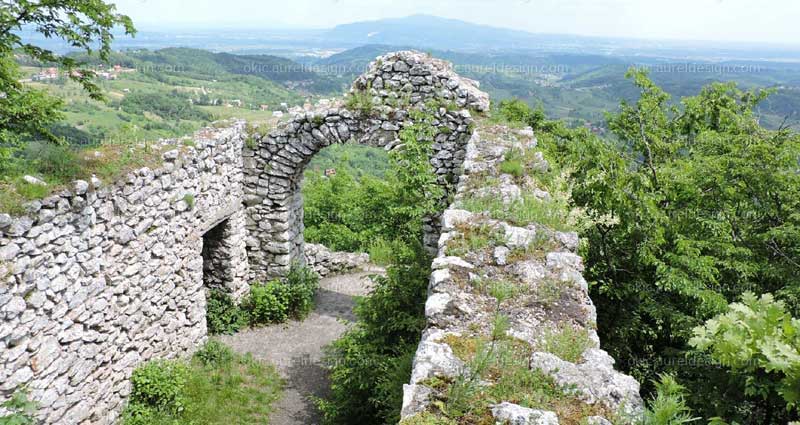
In Dragojla's honour, and in memory of that ascent, one of the paths leading up to Okić was named after her and is today known as "Dragojla's Path." However, anyone who reads her description of the climb and then walks the path named after her will be able to conclude that this was certainly not the route she took, for nowhere along it does one encounter any chasm or precipice that is impassable — or, as Dragojla puts it, "for all at once a chasm had opened before us and for me there was no possibility of going further," and, as she goes on to say, her companion placed "a stout plank" — that is, some kind of log — and "stretched it across the chasm and led me safely to the other side."
From this description one can conclude that the chasm described — which they crossed with the help of a log — is the place known as the "bloody bridge." This spot does not lie on the path leading to the summit along the present-day trail that bears Dragojla's name, yet there really was once a small wooden bridge there. More than two centuries had passed between the departure of Okić's last inhabitants and Dragojla's ascent, and the bridge had rotted and collapsed, which is why a log had to be used in its place.
That the bridge which had stood there in Okić's more glorious days had indeed fallen down and been replaced by a log is further confirmed by a text written by Dr. Franjo Bučar when describing an excursion of the "Croatian Falcon" society to Okić in 1897, published in the journal "Gimnastika," in which he wrote, among other things: "...and the bridge by which one crosses the chasm separating the inner from the outer castle has already completely fallen apart, so that one must cross the chasm on a bare log."
It is worth noting that a log remained at that spot until the 1960s, when that section was underpinned with stonework. Whether it was the same log placed there by Dragojla's companion throughout all that time, or whether someone had at some point replaced it with another, is not known.
From all of the above I conclude that Dragojla's ascent to Okić was a remarkable feat and that she absolutely deserves to have a path named in her honour — yet it can be asserted with considerable confidence that the path currently bearing her name is not the one that Dragojla Jarnević and her companion took on 11 September 1843. It is my view that greater honour would be done to her memory if the path from the mountain hut to the summit were named after Dragojla Jarnević, all the more so since it is along that path that one finds the very kind of chasm she describes — the same feature mentioned by Dr. Franjo Bučar.