
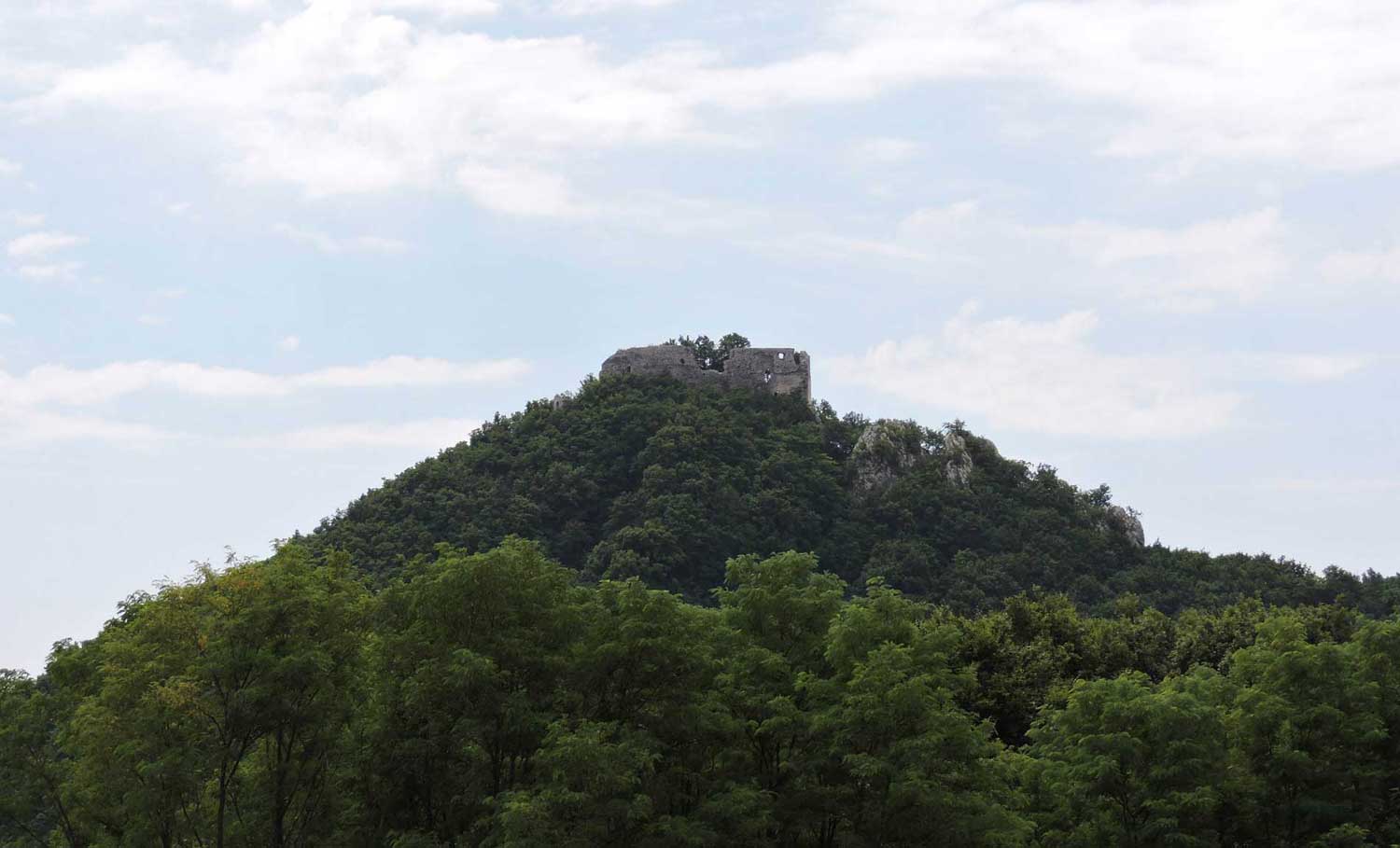
Over eight centuries of history, the local population living beneath Okić suffered many hardships. This rather infertile region was frequently struck by natural disasters: hailstorms, frosts, droughts, floods and crop failures, while disease ravaged both vineyards and livestock. Until the widespread cultivation of potatoes took hold in the mid-19th century, famine following a bad harvest was a recurring affliction that could engulf entire districts. Given the prevalence of timber construction, fires caused enormous damage and were almost impossible to check until the early 20th century, when firefighting equipment and organised fire protection finally became available.
Besides the hardships already mentioned, and the feudal lords — some of whom oppressed the people — and foreign armies that burned, plundered and pillaged, there were frequent bands of outlaws and brigands who extorted their own tribute by force, targeting above all the wealthier peasants. Here I shall say something about the activities of Joco Udmanić, the most celebrated Croatian outlaw of the 19th century in this area.
During the 19th century, Okić was rarely mentioned in speech or in print. Apart from Vukotinović's poem "The Crows of Okić", the exception is the 1860s, when the Agramer Zeitung, a Zagreb newspaper published in German, carried an article in its local sketches column describing the beauties of Okić, its vineyards and its people, and even then proposed that this splendid setting and its magnificent landscapes be put to use for tourism. In 1864, Ivan Kukuljević published his well-known study Okić grad, contributing greatly to an understanding of the castle's rich past and the antiquity of the site. Not long afterwards, all the newspapers were reporting how Joco (Josip) Udmanić, a celebrated outlaw from Moslavina, had carried out a lightning raid some hundred kilometres from his home territory.
In his day, Joca was the terror of wealthy merchants and innkeepers and the darling of the common people, who believed that he, like all true outlaws, robbed the rich and powerful and gave to the poor — which, in the case of our own Robin Hood, was largely true. The exploits of Joca Udmanić inspired stories, songs, novels, plays and even musical compositions. The extent of the fear he inspired is illustrated by the fact that Bishop Strossmayer did not dare set out on a journey to Jasenovac, where he was to take the waters, giving rise to the well-known saying of the time: "The Bishop Štroca would go on his way, but the outlaw Joca gives him fright!" It is also worth noting that the German author Friedrich von Gagern, moved by all of this, wrote a novel entitled Ein Volk (A People) in which he treats the outlawry of Joca Udmanić, whom he calls Marko Ubranić; and what is most interesting to us is that the entire action takes place in the area around Okić, whose beauties Gagern describes and uses as the setting for his romantic narrative. It should likewise be added that as early as 1937 the Slovenes translated that novel into their language and published it in Ljubljana.
In addition to the newspaper accounts written by contemporaries, this raid by Udmanić is known to us through the description of a local man, the priest Stjepan Mrakužić, a native of Poljanica, who published an article entitled "The fiftieth anniversary of Udmanić's outlawry in Kotari" in the Samoborski list, no. 22, dated 31 May 1914, and no. 23, dated 6 June 1914, from which I shall take several passages.
In 1865, Udmanić arrived with his outlaw band by way of Podsused, reaching Rude and then continuing on foot to the village of Kotari, where a prosperous family by the name of Tandarić lived. The Tandarićs had recently sold wine from their cellar to a man from Carniola and had received payment in cash. Word of this, so it is said, reached Zefa pl. Pavlović of Repišće, who passed the information to her lover Andrašin, one of the more prominent members of Udmanić's band — most likely a man from the Prigorje or Zagorje region who knew the area well. Since the men of the household were away from home, the outlaws fired their guns to frighten the women and neighbours, broke open a chest containing cash and gold coins, and fled in the direction of Zagreb.
The incident unfolded as follows (described by the Okić parish priest, Fr. Kućas, on the basis of eyewitness accounts):
"It was around the year 1865. The Tandarić family of Kotari had sold wine to some man from Carniola at their house in Okić. Zefa Pavlović was present during the bottling. It was there that Zefa caught wind of the fact that they had received money, and she informed her associates. In the autumn, during the grape harvest, some of the Tandarić men were away harvesting in Okić, and others were in Prigorje on the far side of Plešivica. One night, around midnight, Udmanić turned up at the Tandarić household with Andrašin — or Antić — and the brothers Uzelac, four of them in all. They had travelled by cart from Podsused to Rude and then continued on foot to Kotari. Only women and children were at home. They demanded money; armed with rifles, they fired shots, and everyone was seized with mortal terror. The woman who told me the story today — she was a little girl of six at the time — says that she was kneeling on the bed, her hands clasped together, raised towards them, begging them to leave her in peace. They searched the entire room and found an old box of solid wood, locked, inside which were ducats and scudos. They forced it open with great difficulty, took the money and all the better clothing there was. The women were afraid they would drive off their oxen — they had four of them — and cried out for help, but no one dared come near for fear of the outlaws' gunfire from their rifles and pistols.
The parish priest at Rude, Tandarić, a local man, sent a report to Samobor the very next day about the break-in, and they say that Udmanić and his associates were indeed caught and questioned in Samobor. Udmanić, however, managed to escape from prison, and later, so they say, made his way to Moslavina and continued his raids there for some time, until he was eventually caught at his mistress's house in the village of Potok near Popovača and killed in the ensuing struggle.
The Tandarić family recovered their money and belongings — some say they got back more than was stolen from them, since Udmanić had money from other thefts as well, while the family themselves say they did not even get back what was rightfully theirs. God alone knows the truth of it."
The tale of Udmanić's outlawry and of Zefa Pavlović was passed down from generation to generation, and has been partly preserved to this day. Even now, in the villages beneath Okić, a wicked woman may still be heard condemned with the words: "Don't be like Zefa Pavlović!" The saying lives on, even though almost everyone has forgotten who Zefa was, when and where she lived, and her "deeds" have grown into many a tale coloured by the vivid imagination of the common folk.
The story of the old woman into whose heel Udmanić drove nails as punishment for cursing him struck fear into the bone of simple people, while his written messages — sent ahead to wealthy men warning them he was coming and stating exactly how much plunder they were to have ready — threw these recipients into such a state of agitation that they trembled at the mere news that a letter was arriving by post. To ensure their safety, guards kept watch through the night over parish houses, merchants' premises and manorial courts, and in some places bonfires were lit to ward off the outlaw.
In particular, both the Samobor and Jastrebarsko districts were at that time in a state of constant alarm, for it had become known that Udmanić had associates there too. Further alarm was caused by threatening letters received by well-known local men of means and certain local parish priests — among them Majcenić of Sveta Jana, Roneš of Plešivica, and Tandarić of Rude — to whom Udmanić had announced his intended visit. On that account, guards kept watch every night at their homesteads and bonfires were lit.
It goes without saying that many such letters were not Udmanić's at all, but were written by others — whether out of spite, or simply as a prank, to see how badly someone's knees would shake...