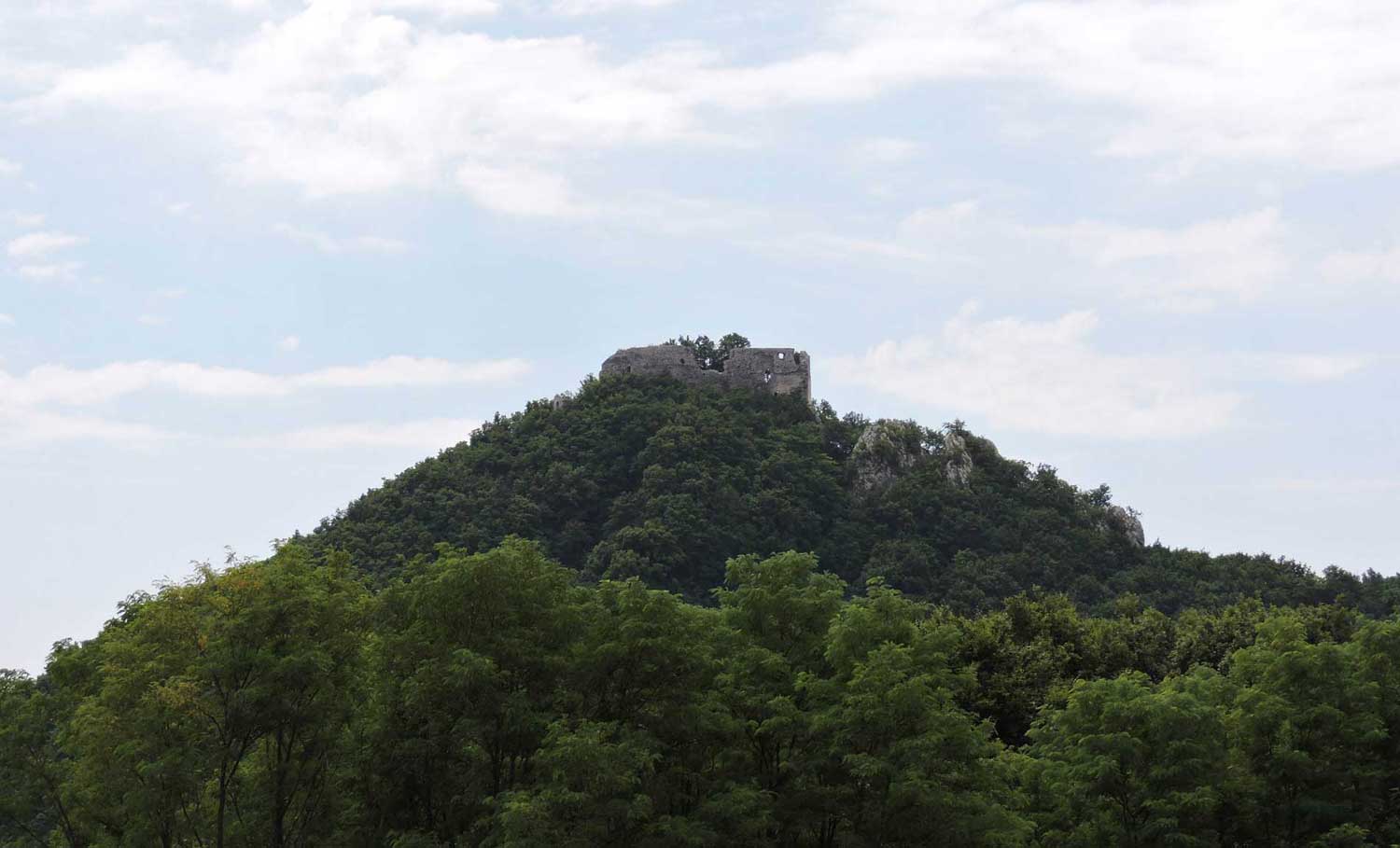
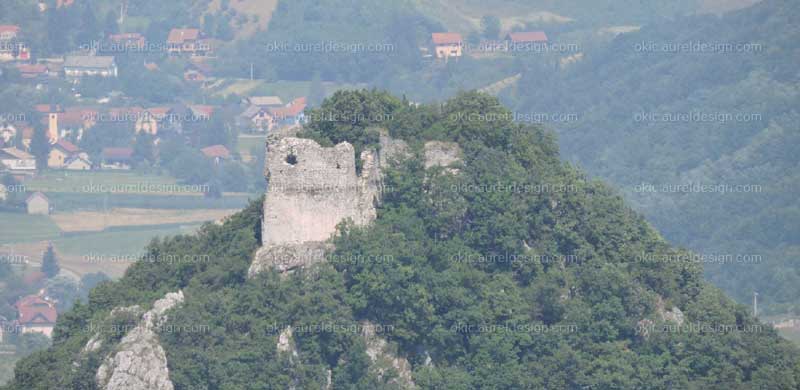
"Beneath Mount Plešivica, whose ridge forms the western boundary of civil Croatia towards the Croatian Military Frontier and the neighbouring land of Carniola, and beneath the nearby hill of Terihaj, which raises its head towards the north-west, there rises a sharp, rocky knoll. Its crest is pressed down by grey crags, and upon those crags sit white walls, half in ruins.
These walls are the remains of one of the oldest fortresses in the land of Croatia. Antiquity gave this castle the name Oklić, from the encircling mountain terrain, and it was later called Okić Castle...
Almost the whole of Croatia lies at the feet of the observer, and there are few places with so distant and wide a prospect as the very site of the ruins of Okić Castle."
These were the words written by Ivan Kukuljević Sakcinski back in 1864 — a man who was "called the father of our history," and at the same time the founder of local historical writing about Okić and, by extension, of the regional history of the entire Okić area.
In his honour, his son Božidar wrote in 1891 "a poem from Croatia's past," which he entitled "Sinda," after a supposedly Mongol beauty of the 13th century, the beloved of Dražen, son of Count Ivan of Okić. It opens with verses in memory of Ivan Kukuljević Sakcinski, the father not only of Croatian but also of local Okić historiography, and we reproduce its first stanza here:
To you, who throughout your lifetime
Gave your people countless books
And by the whole Croatian nation
Were called the father of our history.
The younger poet Kukuljević clearly loved and knew Okić and the Okić area well, as did his father — for in its beauty and tranquillity many Croatian poets, painters, politicians, mountaineers and day-trippers have found peace, beauty and variety alike. He addresses it with an almost tender familiarity: "Ancient Okić Castle, proud one," and "Oh, glory to you, castle amid these mountains," yet what he longs to see upon the fortress is:
On Okić Castle waving gloriously
The red-white-blue tricolour
There is scarcely a castle in all of Croatia that occupies so prominent and commanding a position — perched like an eagle's eyrie, dominating the near and distant landscape, standing like an eternal sentinel on the edge of the Kupa and Sava valleys. The position might perhaps be compared to that of Klis above Split, of which a folk singer says — and the words might equally apply to Okić — "Woe to Klis, for it stands on rock, and to the rock, for Klis stands upon it!" A similar impression strikes the eye from Medvedgrad and Lobor, and likewise from the tower of the church at Motovun or Buje — which is perhaps why the Venetians called the latter "the Sentinel of Istria."
Okić stands among a chain of castles and fortifications that guard north-western Croatia — or, in the medieval period, Slavonia, as that name then extended this far — from the bank of the Drava to the upper Kupa, protecting the region against attacks from the east such as the Tatar invasion of the 13th century or the Ottoman incursions of the 16th. Arranged in this chain were: both Kalnik fortresses, Medvedgrad, Susedgrad, Okić, Slavetić, Dubovac (today Karlovac), Ozalj, Žumberak, Novigrad on the Dobra; Zvečaj on the Mrežnica; and other castles towards the sea, such as Modruš, Ogulin, Hreljin, and others.
These fortresses also defended the neighbouring free towns and market settlements that stretched along the eastern line of roads running from the Drava and Sava regions towards the sea — among them Koprivnica, Križevci, Zagreb, Samobor, Jastrebarsko, Karlovac (from 1578), Slunj, Ogulin, and all the way to Bakar or Senj. Okić had its own place in that chain of strongholds for as long as the threat of incursion remained — from the east, out of Bosnia, or from the west, out of Carniola. When that threat finally lifted following the defeat of the Ottoman-Wallachian army at Sisak in 1593, the role of these fortifications likewise came to an end. Before the age of artillery they had been all but impregnable, rising like teeth from the pointed, isolated summits of their hills.
The earliest written record of Okić as an estate — and consequently of its fortress — postdates Zagreb by less than a hundred years. The oldest document to record the names of Okić, Krapina and Podgorje was issued in 1193. Kalan, Bishop of Pécs in Hungary and, at that time, governor of Croatia (and Slavonia) on behalf of the Hungarian-Croatian Árpád rulers, issued a special charter towards the end of the 12th century determining that the Zagreb church and its bishop Dominik were entitled to a tithe, drawn principally from the aforementioned feudal estates. While Krapina went on to become a town — today the seat of a new county, which celebrates its anniversary with due ceremony — Okić is nothing more than the ruin of what was once a mighty fortress, and Podgorje, the seat of a medieval parish, has vanished entirely.
From the period of the Croatian native dynasty of the Trpimirovići, not a single written record survives concerning the existence of Okić Castle, its župа and its estates, though it is generally assumed that they predate the 8th century. The first to advance this view was likewise I. Kukuljević, with the words that "there is no doubt that (Okić Castle, ed.) already stood in the time of Croatia's native rulers."
The same is confirmed by the archivist and historian Emil Laszowski, who, alongside the župa of Podgorje, also raises the possibility that a župa of Okić existed. He writes: "Without doubt, Okić Castle and its territory constituted a separate župa in the districts between the Kupa and the Sava during the period of Croatia's independent statehood. In all likelihood, the territory of the later free market town of Samobor and of Lipovac Castle also fell within the župa of Okić. The župa of Podgorje thus bordered this župa to the west; Carniola and the River Sava to the north; the župa of Turopolje; and partly the župa of Podgorje with the River Kupa as far as the vicinity of Kravarski to the south. Right up to the close of the 12th century we have no news of Okić — for not a single document has been preserved that speaks of it. As happened everywhere in Croatia up to the Kupa, so too the ancient župa of Okić came to take on the character and institutions that the first Hungarian-Croatian kings were introducing into our homeland."
Under the rule of the Croatian-Hungarian Árpád dynasty, the Croatian lands retained their own self-governance, their own duke, bans, assemblies, and even minted their own coins — the banovci. The old Croatian tribal župas were amalgamated or grew into larger counties into which the entire joint state was divided. In the region between the Sava and the lower Kupa, the first county was that of Podgorje, with its seat in the aforementioned Podgorje, recorded in Latin as "comitatus de Podgoria," or Podgora or Pogoria. It is in this region that the greatest number of memories of the old Croatian župas, their nobility and their hereditary lands have survived into more recent times. On this subject, Laszowski writes: "Clear proof of this is furnished by the old brotherhoods or communes (of kin): Turopolje, Draganići, Cvetkovići, Pribići, Krašići. In Turopolje we still find today (1899, ed.) a 'župan,' and such we find in earlier times also in Draganići, Stankovo, Cvetkovići. It is precisely in these communes, in their past, that we encounter relations which essentially characterise the former Croatian župa, which extended across that district." In these lands, Croatian župan and tribal customs continued to live on, despite the feudal division of society into greater, middling and lesser nobles — the so-called single-village nobles, who possessed only one sessio or holding (village). Hence the term "single-village nobles"; the common people also called them šljivari — "plum-growers" — a subject on which A. Šenoa wrote a historical ballad.
In the first written record, from 1193, the name Okić appears as Okich, but in later Latin or Hungarian documents it is spelled in various ways, for example Okych, Oclych, Ochylich, Ochyz, Ochinz, Okiz, Achuz, Ochus, and similar forms. Its first recorded lords, the Counts of Okić, are likewise spelled variously, most commonly as "Comes de Oclych." Under King Andrew II, a certain Okhuz is mentioned as Croatian ban (in 1214), a man who held high offices and enjoyed certain lands. The first recorded lord of Okić (Oklić or Okolić) was a 13th-century figure named Jaroslav or Irislav, who had a son and a grandson both named Ivan; all of them are referred to by the name of the Counts of Okić, who distinguished themselves in the battles against the Tatars when they broke into Croatia in 1242.
After the Counts of Okić, or more likely after Okić Castle or the Okić area itself, there are to this day several surnames that recall their origin — for example Okić, Okićki, or Okičić.