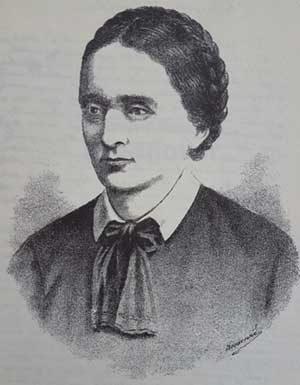
The Croatian writer and teacher Dragojla Jarnević was born in Karlovac on 4 January 1812 as Caroline Jarnević, the daughter of Janko Jarnević and his wife Anna, née Mlinac. Dragojla was the third of six children. She had two older sisters, one younger sister, and two younger brothers. The Jarnević family were Roman Catholic and belonged to the middle social stratum by means. Her father, Janko Jarnević, was the owner of an ironmonger's shop and a highly regarded and respected citizen of Karlovac in his day. By Dragojla's own account, she was her father's favourite child. Janko Jarnević died at the age of 66 in 1819, however, when Dragojla was only seven years old, and the shock of his death left a profound mark on her.
Her mother, a young widow of 35 with six children — the youngest barely 13 months old — proved unable to manage the family business and finances, and the family's economic situation rapidly became precarious. The deepest pain for Dragojla, however, came from her relationship with her mother. In her Diary she writes of how her mother never embraced her, and how, even when Dragojla was a small girl, she told her outright that she did not love her — giving as her reason that Dragojla was the only one of her children she had not breastfed. This troubled relationship with her mother left a lasting emotional void in Dragojla.
By her own account, she was the sharpest-minded of all the children, but also the most frail in health. She received a formal education until the age of 13, when her mother sent her to stay with her sister Ljuboslava Peterle — ten years her senior and known as Jula — who had received the best education of any of them, thanks to their father, and who could use Dragojla's help around the house. Quick-witted and eager to learn, Dragojla soon became an accomplished seamstress and cook; but her hunger for knowledge and new skills drove her to read and study with stubborn persistence. Visitors to the house would bring books for her sister to read in her spare moments, and Jula even went so far as to forbid Dragojla from reading them, keeping them under lock and key — but Dragojla outwitted her sister, secretly pilfering the books and devouring them greedily, spending many a night awake over their pages, often in part because she was determined to overcome the health problem that had troubled her since childhood. Dragojla had struggled with incontinence from early life until her fortieth year, and it was this, more than anything else, that shaped her resolve never to marry.
When Jula's second son died, their mother called Dragojla home to help her and the younger siblings. Her sister Vera, two years older than Dragojla, was described in the Diary as being afflicted with painful muscles, while the sister three and a half years her junior was still too young to be of much use, and so the whole burden of the household fell upon Dragojla's shoulders. She was deeply wounded by the injustice of watching her father's estate dwindle away as her mother spent freely on her sons and gave generously to the eldest sister. Turning inward, she endured in silence — working through the day and reading through the night, discovering much about herself in those books and effectively educating herself. Arguments with her mother over reading were frequent; her mother would accuse her of idling when she had a book in her hands. She became a skilled dressmaker, capable and competent in every domestic task, yet her thirst for knowledge remained unquenched — and the schools of the day offered no way to satisfy it. Working by day, reading by night, and wrestling all the while with her health problem left Dragojla physically exhausted.
Her mother also urged her to marry when an older, wealthy widower came to ask for her hand, but Dragojla refused with revulsion. She could not imagine becoming someone's wife, not after all the time and effort she had invested in mastering various trades and securing her independence. She had also noticed that most people were poorly educated and ignorant, with the exception of lawyers and clergymen. When a suitor came for her younger sister Bogumila, known as Minka, who had not yet turned 15, her mother consented, for the young man was an only son of 19 whose mother was wealthy. He was disabled, having broken his left leg at the knee as a boy and being obliged to walk with a crutch. The family owned two breweries, at Dubovac and Rakovec. It was to the latter that her sister moved after the wedding, and Dragojla, then just turned 18, followed to help her.
Dragojla was an attractive young woman, and because she delighted in company and conversation on every subject, many young men enjoyed her company and paid her court. Yet as a proud and God-fearing woman she never allowed her honour to be tarnished. When rumours began to circulate that she had compromised her feminine dignity, she was deeply hurt; she left her sister's household and returned home, where she threw herself into writing. She found within herself the strength not to take too much to heart what envious people were saying about her, and she resolved firmly never to stain her reputation or her honour. Although her brother-in-law Peterle offered her a wealthy husband before she had turned 19, she declined; and from her diary entries it is clear that the principal reason for this decision was, in fact, her struggle with incontinence.
She was devoted to theatrical performances at that time, and whenever a troupe of players came to town, Dragojla would not miss them for anything. She also loved going to the grape harvest every autumn. These were the two things she truly adored, and the occasions that drew her out among people. When her eldest sister gave birth again, this time to a daughter named Zorka, Dragojla was overjoyed and threw herself into caring for the child — sewing, knitting, keeping watch over her day and night. Around this time yet another wealthy widower with no children appeared and proposed to Dragojla, but she refused him as well, despite encouragement from both her mother and her brother-in-law Peterle.
When Dragojla was 20, her brother Vatroslav brought home a man by the name of Franjo Friedrich, who thereafter called frequently and in time declared his love for her. Just as she had refused other suitors, she refused Franjo Friedrich all the more readily, since he struck her in no way as a man she could love. It was Franjo Friedrich who brought the first notebook into which Dragojla began writing her diary, a few days before the start of 1833. She began the diary in German, for until then German had permeated every aspect of her life, including conversation at home; from 1841 she began writing it in Croatian. It is worth noting that Dragojla never achieved a complete command of Croatian, but the diary shows, over the years, clear progress and the considerable effort she devoted to learning the language.
She stayed in Graz from 14 May 1839 in order to perfect her dressmaking skills. While walking on the Schlossberg hill she chanced upon some verses written in Croatian on a tower wall, and was so delighted that she added a text of her own in Croatian. She decided to leave Graz on 20 August 1839 and travelled to Trieste, where she worked as a governess. On returning to Karlovac she attempted to establish a private school for girls, and she made the acquaintance of the author of those verses she had found in Graz — the Croatian writer Ivan Trnski, seven years her junior and the greatest lyric poet of the Illyrian movement, who became a close friend. She later taught children of both sexes in her own home, and was particularly active in promoting awareness of the need for better education for girls.
Joining the Illyrian — that is, the Croatian national revival — movement profoundly shaped Dragojla Jarnević's political identity. Although she had until then written exclusively in German, under the influence and encouragement of Ivan Trnski she wrote her first poem in Croatian, "Želja za domovinom" ("Longing for the Homeland"). She published patriotic poems and texts in Croatian in the revival journals, despite having been raised on the German language and its literature. Her novel "Dva pira", set against the revolutionary year of 1848 and written in the Romantic tradition, appeared in instalments in "Domobran" in 1864.
Her most literarily significant work is her intimate "Diary," written intermittently over a full forty-two years beginning in 1832. Its twelve hundred pages of manuscript contain not only autobiographical entries but also Dragojla Jarnević's perceptive observations of prominent contemporaries and notes on political events. This precious diary was first published in 1958 by Stanko Dvoržak, and the complete integral version did not appear until 2000 (edited and annotated by Irena Lukšić).
Dragojla Jarnević also wrote the dramas "Veronika Desinićeva," "Marija, Queen of Hungary," and "Duvna," which, judging by their titles and her literary talent, must have been highly interesting and valuable works; sadly, they have been lost. For her time she was a remarkably progressive intellectual, distinguished as an ardent Illyrian and a champion of women's rights. She numbered among the most eminent participants in the Croatian National Revival, and her portrait was included among the great figures of the Revival on the celebrated broadsheet "Men of the Illyrian Age." How highly regarded she was is evident from the fact that only two women appeared on that broadsheet — Countess Sidonija Erdödy Rubido and Dragojla Jarnević.
Dragojla could have chosen from among many men in her time, for she was a very beautiful and attractive woman, and moreover educated, a prose writer and a poet. The records tell us that she had indeed many admirers, one of whom remained the great, unassuaged love of her life — Ivan Trnski. Though she was in love with Trnski, she never married, and Ivan Trnski wedded a foreign woman with whom he had five children. She rejected all her suitors with an obscure feeling of shame and sinfulness, and the root cause of this was above all her health condition and her constant struggle with incontinence, and the shame that would have followed had it been discovered. Dragojla was a deeply devout and God-fearing woman, but equally proud of herself and of what she had achieved in life.
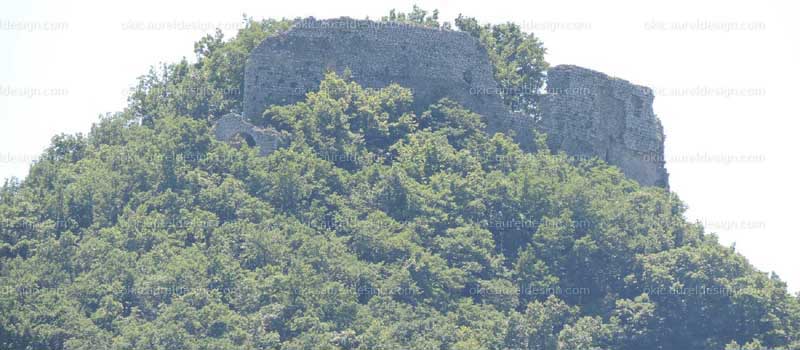
She saw Trnski from time to time, when he came to her native Karlovac or when she visited him in Gvozd or Glina. She devoted many pages of her diary to him, yet her consuming love did not prevent her from describing the honourable Ivan Trnski as a vainglorious, conceited and self-centred weakling who had married a foreigner, risen to the rank of major in his career, later become a member of parliament, and allowed not one of his five children to speak Croatian. Contemporary opinion already held that Trnski had dedicated his "Kriesnice" to the woman who might have been his, Dragojla.
She never managed to have a single work published in the literary journal "Vijenac", to which Ivan Trnski had given its name. Trnski's own works, by contrast, appeared in "Vijenac" regularly. She blamed him above all for this, and accused him of having described in his story "Prieki liek" an episode from her own life that was in fact "a bare-faced lie". Dragojla Jarnević died in Karlovac on 12 March 1875, and her name finally appeared in "Vijenac" on 3 April 1875, in an obituary published under the telling title "Pouka. Vjekopis Dragoile Jarnevićeve" by none other than Ivan Trnski himself.