
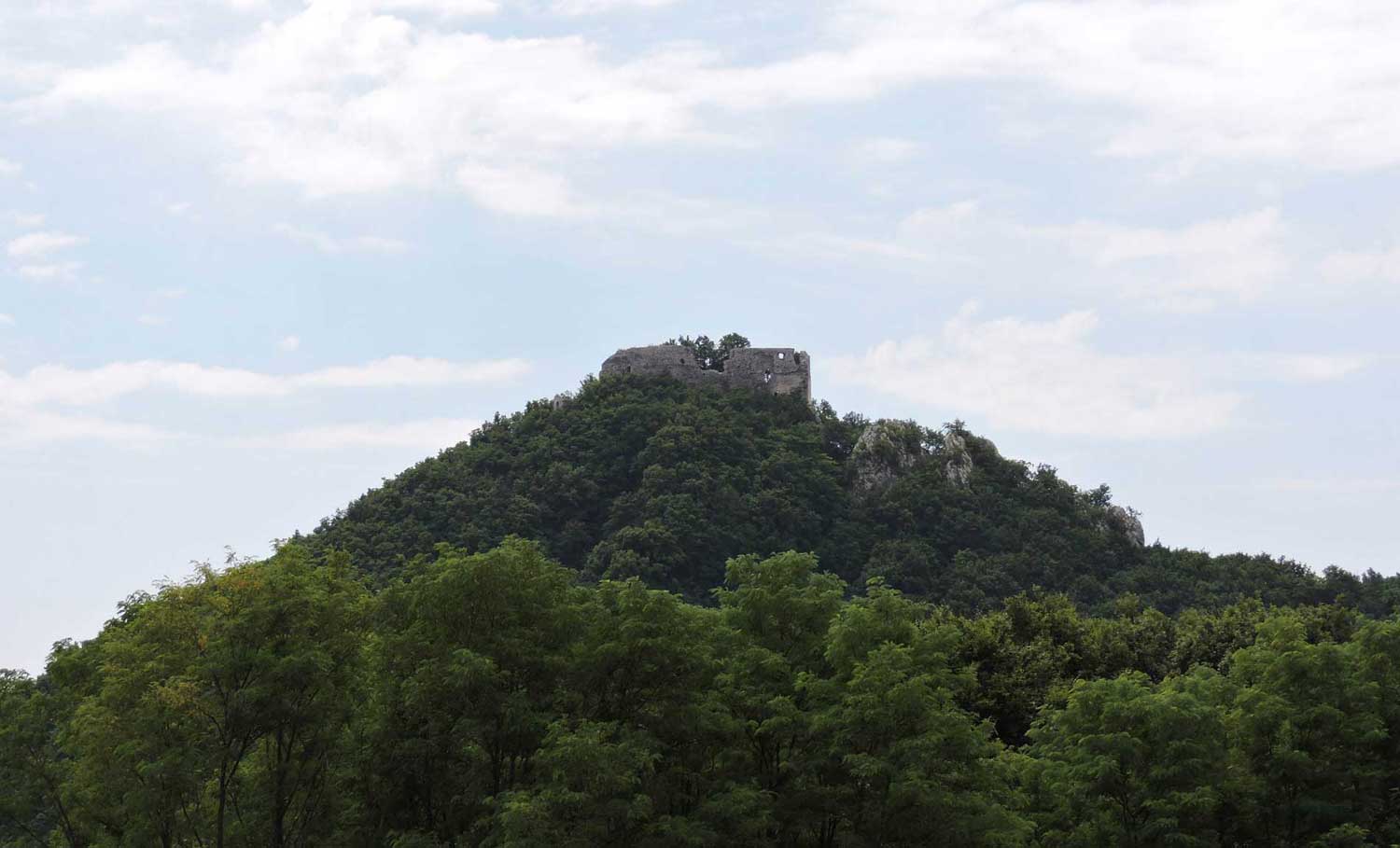
Whether you are driving towards Zagreb from the south via Karlovac, from the north via Krapina, or simply gazing from the newer western suburbs of Zagreb at the sunlit slopes of Plešivica, your eye will always pause, if only for a moment, on the craggy outline of Okić. Few noble fortresses command so dominant a position or control so wide a stretch of territory, and very few medieval noble castles in Croatia are as well preserved as Okić. Yet the full genius of its siting — the simplicity and at the same time the remarkable effectiveness of its defensive system — can only truly be appreciated when you decide to climb to its walls. Okić stands apart from other noble fortresses not only because of its magnificent situation and the high degree of preservation of all its parts, but above all because of the exceptional significance of its structures, a great many of which belong to the Romanesque period. This makes Okić unique among the medieval noble castles of continental Croatia.
The name Okić reaches deep into the early history of the Croatian people. The existence of the fortress of Okić on the slopes of Plešivica was first recorded in writing in 1193, but the name itself is undoubtedly far older — perhaps as old as our own presence in this region. The fortress was in all likelihood considerably more ancient still, having belonged first to Illyrian tribes and later serving Roman legions as an outstanding vantage point for observing the surrounding countryside and as a signalling station of the age — for sending light and smoke signals. It is possible that the name Okić, or some earlier form of it, was already in use in those distant days when the Romans ruled these lands.
The first Croatian scholar to reflect on the name of Okić Castle was Ivan Kukuljević Sakcinski, back in 1864, comparing Okić to a living being that "raises its head above the rest", and then describing how "a pointed rocky hill rises skyward, its ridge pressed down by grey crags, and upon those crags sit white, half-ruined walls". Kukuljević maintains that this is one of the oldest fortified sites in Croatia, and on the question of its name he states explicitly: "Ancient times gave this fortress the name Oklić, from the enclosed mountain space surrounding it, and later it came to be called Okić Castle." From this we may conclude that he believed the name to date from antiquity — that is, that it existed even before the arrival of the Croats.
According to certain linguistic scholars working in the field of historical linguistics — among them the academician Radoslav Katičić — the name of Okić Castle derives from the Latin *Mons acutus*. The same view was expressed by Petar Šimunović, our foremost authority on historical family names and geographical terms, who argues that the root of the name is the adjective *acutus*, meaning "sharp" in Latin. In Croatian, hills of this character are called *oštrc* or *oštrac*, a form that survives in the Samobor uplands in the peak known as Oštrc. When the Croats settled the region, they adopted the name *Acutus* for Okić, but at that time the sound a was not pronounced as such but rather as o, giving *Okutu*; the sound u was subsequently rendered as i, yielding *Okit(u)* and finally Okić. The full original form was in all likelihood *Mons acutus* — that is, Sharp Hill — whereupon the word *mons* (hill) dropped away in common usage, leaving only the adjective *acut*, which became *okit* and then Okić.
The name Okić thus derives from the Latin adjective for "sharp" and is one of the oldest place-names of its kind — effectively a borrowing of a Romance word that the Croats adopted, slightly modified, and have retained to this day. Its native Croatian equivalent is the name Oštrc.
Watching it from a speeding car as it thrusts powerfully towards the sky, aware that its walls have stood for several centuries and have long been left entirely to themselves in an endless and dramatic struggle with nature, we seldom stop to consider the danger of its final collapse. If you draw close enough, you will often see hawks resting at the top of its walls — or perhaps they are simply surveying the valley from Okić's heights, just as the castle's lords once did. Despite the frequent visitors, hikers chief among them, these proud birds feel quite at ease perched on the ruined and weathered ramparts, much as the owners of Okić must have felt secure within their cramped but solid stronghold. The perfect choice of location, and the simplicity combined with the remarkable effectiveness of its defensive system, will only reveal themselves fully when you make the decision to climb to its walls. While we cannot be satisfied with the state of its fabric or with the attitude that has been taken towards its protection up to now — an attitude that, it seems to me, has not much improved — we can at least take some comfort in the fact that researchers have shown considerable interest in its history and in interpreting the remains of its structures.
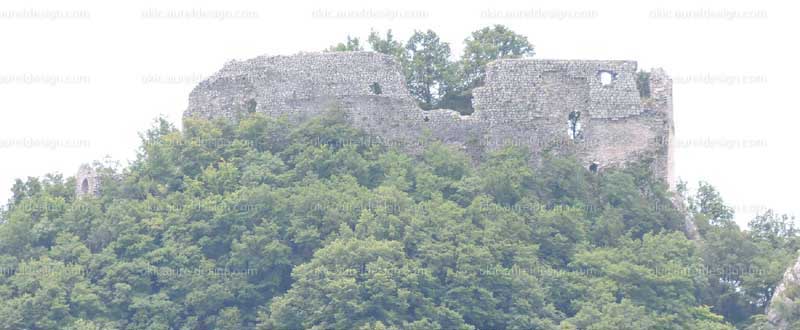
Okić — the castle of the Frankopans and the Erdödys — was besieged by the Turks three times, and attacked by other armies besides, yet it was never taken. For eight centuries of its history, the castle was governed by Croats. Okić has played a very important, if little-known, role in Croatian mountaineering, literature, scholarship, journalism and music. It appeals to every form of hill activity, from alpinism and demanding routes to gentle hill walking, and it offers something rare in Croatian mountains: a climbing trail secured in the alpine manner with fixed pegs and steel cables. On these pages I set out the more significant episodes from Okić's past, and aim to give some sense of the importance of this never-conquered, now ruined castle.