Joco Udmanić – life story
In a story told in three parts, I shall attempt to reconstruct the life of Joco Udmanić, the most celebrated outlaw and brigand of Moslavina, and to tell his story as accurately as is possible — though we shall never be able to establish with certainty every detail of this Moslavina robber's life. Driven by desperate poverty and want, as well as by the injustice of a system that bore down hard on the poor, he became an outlaw who lived by a wholly unexpected and singular code for a man of his kind: he was firmly opposed to robbing the poor. Indeed, many of the poor received from Joco Udmanić the very money he had plundered from wealthy merchants, large landowners or parish priests — a fact that led many a peasant to refuse to report him to the authorities and to shelter him instead. Many songs were composed in his honour, many tales were written about him, and an operetta bearing his name was even written and performed. Joco Udmanić was decidedly no ordinary thief or criminal; and through the written accounts and stories of his contemporaries, as well as through the folk tradition surrounding this romantic outlaw — the Robin Hood of Moslavina — I shall endeavour to portray as faithfully as I can a life that led him from poverty and destitution, with a thieving father at his side, onto the road of crime and brigandage: a road that, in the great majority of cases, ends in tragedy.
Joco Udmanić — his real name was Josip — was born in Popovača or the village of Vidrenjak around 1843. He was born to his father Petar Udmanić and his mother Jana. There were five children in the family: the eldest was a girl, Jula, followed by the sons Joco, Franjo, Juraj and Mijo. It was a very poor family, of the kind that was common throughout Croatia in the mid-19th century, following the abolition of feudal relations and the break-up of the communal household system — yet for the peasantry a yet harder era had begun, and serfdom in all but name persisted until the century's end. To this was added a severe agrarian crisis, compounded by livestock epidemics and years of failed harvests.
When conditions in the country grow desperate, people turn more readily to theft, robbery and every manner of transgression, and then, to escape trial or imprisonment, they take to the hills as outlaws. Many went into hiding precisely to avoid military conscription, which at the time lasted a full twenty-seven years. In that era, every able-bodied man was in effect required to serve in the army from the age of eighteen until forty-five — the best years of his life spent under the discipline of the Austrian military, from which he returned to his village worn out, old and broken. It was often honest men who were driven to outlawry by injustice, lawlessness, violence and political circumstances, while larger groups of peasants took to the road out of destitution, hunger and poverty.
And so Joco, too, set out along the well-worn paths of the outlaws. He might never have become a hajduk had his father Petar not steered him that way from his earliest youth. Petar Udmanić was a peasant, a charcoal-burner, with a reputation for theft and robbery. The Udmanić family lived near Popovača in a pauper's hovel thatched with straw, much of which had already been torn away, the whole structure leaning at odd angles. A door in the middle, a small window on each side of it. Inside, a single room: a hearth in the centre, a table, benches along the wall, a chest, and in the corner a sizeable stove, beside which two rifles hung on the wall, while on another wall hung a picture of a saint in a black frame. That was the sum of the furnishings.
Father Petar used to take Joco along on his various thieving expeditions from the time the boy was just seven, using him as a lookout while he broke in and stole. In this way, even in his innocent childhood, the father taught him that one could live off the toil of others — and as the old proverb has it: "What a young man learns, an old man will do." Joco was a presentable lad. He attended primary school, and from his very first years it was plain that he was sharp-witted, one of the best pupils in his class.
When old Udmanić was sentenced to a lengthy term of imprisonment for yet another theft and break-in and was locked away in Lepoglava, where he died not long afterwards, Joco's mother sent the boy to apprentice with a miller, and he duly learned the trade in full. But little good it did him, for he could not escape the constant reminder that he was a thief's son, the son of a burglar who had died a prisoner in Lepoglava. This, combined with the grinding poverty and misery already described, embittered him further, and it is little wonder that he followed in his father's footsteps. Joco himself was known to say: "If only I had held back that first step, things might still have turned out well — but now it is too late."
Joco grew into a strapping young man — tall, fair-haired, brown-eyed, with a round face and beard, remarkably powerfully built, a fine figure of a fellow. He was sharp-witted, quick, and highly resourceful in his outlaw exploits. No one could carry out a break-in or robbery with such audacious disregard for his own life as Joco Udmanić. By the age of twenty he had already accumulated a string of criminal convictions for theft. His so-called "beginning" is considered to be the theft of a pair of oxen at the fair in Kutina — stolen because he had not eaten in several days — which he then attempted to sell at that very same fair immediately afterwards. He was caught and convicted, not only for the oxen but also for having robbed the Popovača merchant Hirsch on four separate occasions, earning him a total sentence of ten years' imprisonment.
Joco might not have received such a long sentence had the gendarmes not had good reason to remember him, for he had once attacked them. It happened when he had just returned from Gornja Jelenska, where he had been learning his trade with a certain miller. He arrived back at his own yard to find gendarmes carrying out a distraint — dragging the pitiful belongings of his mother from the house in settlement of some debt. Joco flew into a rage, wrenched a stake from the wooden fence and brought it down on a gendarme's head. He managed nothing more than to vent his fury: the distraint was duly completed, and Joco barely escaped the remaining gendarmes. In the end he was caught at the aforementioned fair in Kutina, thoroughly beaten, and thrown into gaol.
He spent two years in remand prison, and on the very day before he was to be transferred to Lepoglava following his conviction, Joco managed to escape. He had been put to forced labour in the garden of a lawyer in Križevci and, taking advantage of a moment of inattention from his guard, made his getaway. After fleeing, Joco made for the forests of Moslavina, near the village of Gornja Jelenska. It was in the early autumn of 1865.
Before disappearing into the forest and committing himself to the life of an outlaw, he visited his mother and brothers at home, and on that occasion promised his mother that he would not lay a finger on anyone, nor kill, except in self-defence; that he would not plunder the poor, but rather give to them, for he knew poverty himself.
And so it was. When he robbed the Popovača merchant Hirsch for the first time, Joco kept a small share of the spoils and left the rest that same night on the windowsill of a poor family in his home village. When the household woke the next morning, they found the money on the window ledge together with a note bearing the message: "Ask not where the money comes from. A benefactor." Thus was born the legend handed down through popular tradition of the benefactor of Moslavina, and Joco Udmanić became the Robin Hood of Moslavina.
Joco robbed that merchant Hirsch in Popovača four times over — not only out of poverty, but also out of revenge. The Udmanić family, like all the other poor families of the area, had run up accounts "on credit" with this wealthy trader at steep rates of interest, and that was a powerful reason to plunder the same man again and again.
The principal reason why Joco became an outlaw was the terrible destitution and hunger that beset the Udmanić family. When his father was taken away to serve his sentence, his mother Jana struggled desperately to cope. She would find work as a domestic servant in some household, only to be dismissed within days once people discovered whose wife she was. It was then that Joco began to steal in order to feed the family, and he was known to say: "I will rob every wealthy man in Moslavina and share everything among the poor, so that no one need suffer want any longer."
While Joco was in gaol, the family went hungry again as before, and his younger brother Franjo, driven by starvation, followed in his older brother's footsteps. One day Franjo came home and threw a large piece of bacon on the table. When his mother asked where it had come from, he replied: "Never you mind — just eat. I didn't buy it, I stole it. I've had enough of starving. If the parish priest can eat bacon, why shouldn't Franjo Udmanić?" At that moment gendarmes arrived at the door with an eviction order on account of some debt. Franjo grabbed a kitchen knife from the table and went for a gendarme, but his weeping mother stepped in front of him and begged him to put down the knife; the gendarmes seized their chance, put him in irons, and he ended up in Lepoglava serving a lengthy sentence for theft and attempted murder.
Joco's older sister Jula made a sacrifice in her desire to help her mother and younger brothers: she agreed to marry an older but prosperous man from Vrbovec. Although her mother was reluctant to see her daughter wed a man she did not love, there was little choice in the circumstances. Through a combination of money and pleading, Jula managed for a time to preserve the wretched little cottage so that the family would have a roof over their heads, but even then she was already pressing her husband hard to take their mother and the two youngest brothers, Juraj and Mijo, into his home.
After escaping from prison, Joco made for the forests of Moslavina near the village of Gornja Jelenska and formed an outlaw band. Known alongside Joco Udmanić are the outlaws who served as his companions: the brothers Todor and Jovan Uzelac from Lika, Đorđe Slijepčević (who changed his surname to Popović), Petar (Pero) the Romani man (Jovanović), Ivan Štimac from Lika, Stjepan Prosenečki and Ivan Jandrašin, both from Prigorje or Zagorje. In addition to these, G. Vugrin, Medić, Damjanović and Kuzmanović are mentioned from time to time. The peak of Joco's outlawry and that of his band falls in the period from 1865 to 1867. During that time, Udmanić's company carried out a series of raids from Kutina to Stubica and even in the vicinity of Okić, as we have already described on these pages.
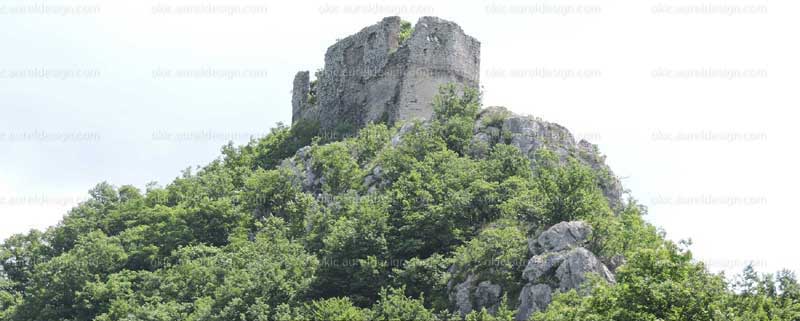
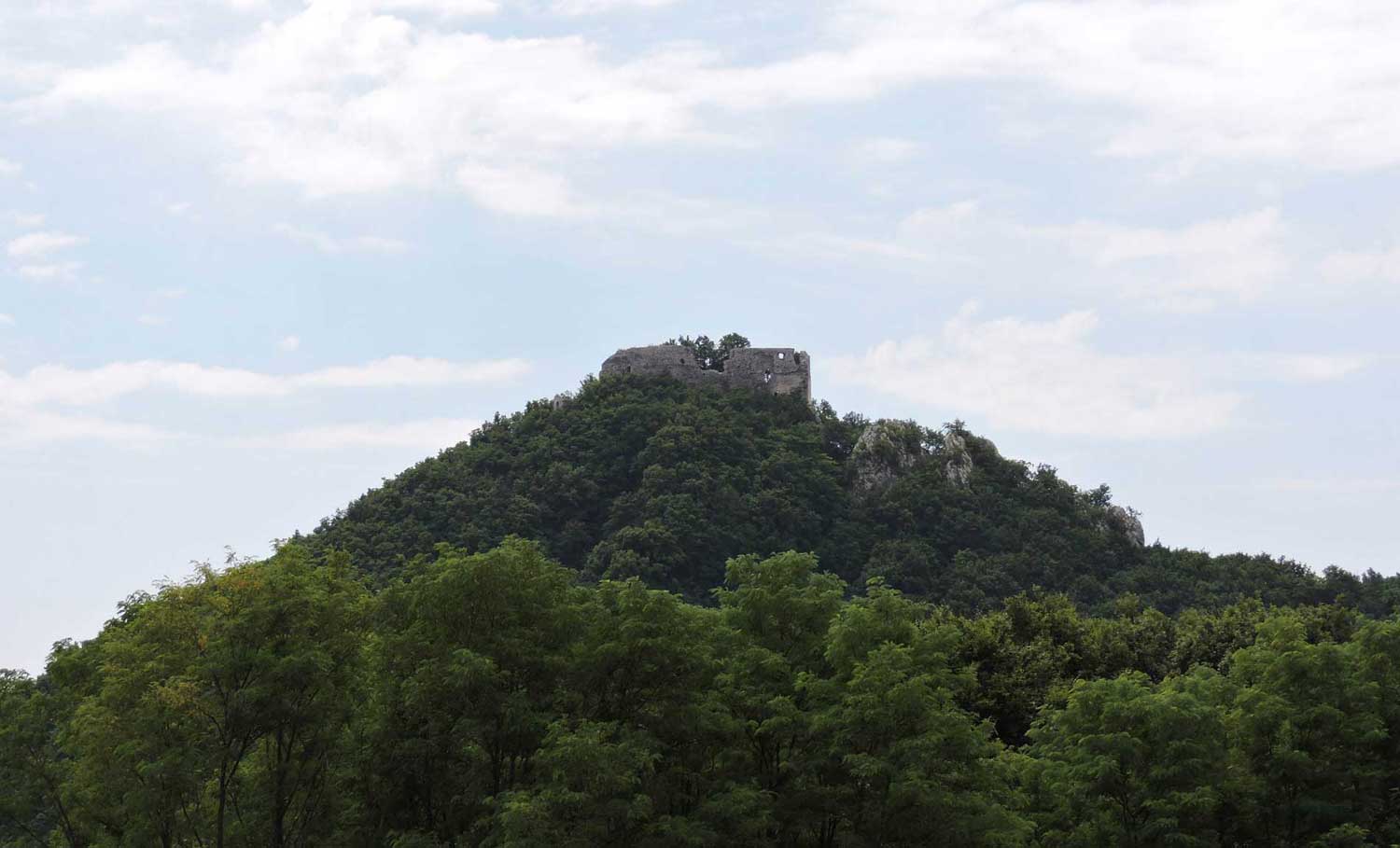
Above the village of Gornja Jelenska stood the ruins of the ancient fortress of Garić. To the north the slope is impassably steep, while to the south a winding path leads up — one by no means easy to climb — to the ruins. Beneath the rock face, cut into the earth, lies a spacious cave that once served as a dungeon; in Udmanić's time this cave was his principal hiding place and that of his associates, for it contained a secret passage leading out to the north side into thick forest. It was they who discovered that hidden entrance to the passage and used it to enter the cave. There they were safer, since no one else knew of the passage, and moreover the lookout in the tower could easily spot anyone approaching who was unwelcome. It was in this cave, at the first gathering after Joco's escape from prison, that Joco Udmanić was chosen as leader — harambaša — of the outlaw band.
No sooner had the leader been chosen than sparks flew between Pero the Gypsy and Joco. Petar proposed that they go raiding at once, for he wanted to steal from everyone, the poor included — something Joco flatly opposed. On that occasion Petar rose to his feet and reached for his knife; Joco, however, stood his ground and calmly told Petar to take his hand off the knife, and that anyone else who thought as Petar did should raise his hand. When two others raised their hands, Joco told them: "Let this be clearly understood: I am against you. I did not intend for us to be a terror to the common people, only to the wealthy gentry. We must protect the people, and the people will repay us for it. Anyone who raises a hand against a poor man will answer to me. That offence will cost him his life. If all three of you disagree, leave this hideout at once and do not come back." Pero hesitated for a moment, but in the end all three offered Joco their hand and remained in the band. Also among the company was Pero's common-law wife Anka, who had fixed her eyes on Joco and made no secret in her glances that she was drawn to him.
Before dawn, Joco woke Jovo, Todor, Jandrašin and Prosenečki and slipped silently out of the cave with them, telling the sentry he would return in two days with plunder. He led them to the outskirts of Karlovac, where, near a ravine, stood the house of a wealthy nobleman, Janko V., whom Jandrašin knew to keep cash on the premises. That late night, the nobleman Janko — a bachelor in his forties — was expecting his servant Stevo Jurić to return from Karlovac with some business news, when intruders appeared in his manor. While Janko lay at ease in his bed, absorbed in a newspaper, he did not hear Joco and the Uzelac brothers enter his room. When Joco levelled a pistol at him and demanded money, Janko leapt from the bed and, being a powerfully built man, shoved Joco so hard that he nearly fell. Todor rushed to help, and after a brief struggle they managed to overpower the nobleman and tie him up.
They then laid him on the bed, still bound, and again demanded that he tell them where he kept his money. When he refused, they began ransacking the room, throwing things about, until the nobleman asked how much they needed. Joco replied that there was a reward of 500 forints on his head and that Janko should give them that very sum. Once the nobleman showed them where the money was kept — though the amount there exceeded what Joco had named — Joco took only the 500 forints and left the rest. He also seized the weapons hanging on the wall above the bed: a sharp handžar, a double-barrelled gun and two pistols, with the explanation "lest you come to any harm by some mishap."
On leaving, Joco stuffed a handkerchief into the nobleman's mouth and bound his head with a towel. It was only in the morning that the servant Stevo Jurić arrived at the house and began to untie him. He explained that he too had been bound all night, having been seized as he was leaving the house, and that one of the men had introduced himself as Joco Udmanić. They had left him in a small wood, where a peasant found him in the morning and helped him. The nobleman went to Karlovac to report the armed robbery. That same day the constables set out to search the entire surrounding area, and the manhunt lasted three days in all; but Joco and his outlaw band were already near their hiding place in Moslavina, where he had divided the spoils fairly, setting aside sixty forints in front of everyone. Petar asked what the money was for, and Joco said he would give it to those in need. Pero objected more forcefully at this, which angered Joco, who said: "as long as I am captain, I will distribute the money as I see fit, whether you like it or not."
Having shared out the money taken from the nobleman Janko near Karlovac, they fell to debating which of the poor peasants deserved the 60 forints Joco had set aside. Pero continued to insist they keep the money, arguing that there were too many wretched people and that it was impossible to be fair in such circumstances. In the end, however, the band agreed to take the money to a widow named Marija, the mother of five children, whose house the constables had visited only a few days earlier, carrying off her one bed and all her benches because she had not paid her taxes. And so, towards evening, Joco and Todor set off for Popovača and, creeping up to Marija's house, knocked at her door. When she opened it and saw who was there, she was frightened, but Joco said: "Do not be afraid, Marija, we mean you no harm. Here, take this money, feed your children, buy a new bed and new benches. This is a gift for you and your children from Joco Udmanić." Marija wept as she accepted the money; her children gathered around her, and when she tried to give her thanks there was no one left to thank — Joco and Todor had vanished into the darkness.
News of the noble robber spread like lightning across all of Croatia. Thus began the legend of Joco Udmanić, the Robin Hood of Moslavina — protector of the poor, champion against the wealthy and powerful. The common people of Moslavina turned Joco into a symbol of the avenger: he made fools of the powerful, slipped through the hands of gendarmes and soldiers, wandered through villages and towns with a heavy price on his head, refused to allow the poor to be robbed, and even gave them the money he had plundered. He became a beloved figure, and people were inclined not to betray him when they saw him — indeed, to hide him, knowing that Joco was far more likely to help them than any official authority.
After delivering the money to the widow Marija, the romantic avenger returned to his hiding place. A sentry reported that a woman was approaching. He ordered that she be brought to him, and when he heard her voice he went out to meet her. It was his great love, his dear Mara Klasić, a girl said to be the most beautiful in all of Moslavina. Mara Klasić was an orphan who had been raised by her uncle Marko Budin and her aunt Bara. They walked a little way into the forest, where Joco embraced her and drew her close. For a time they stood in silence, pressed against one another in a long, ardent kiss.
Joco had planned to marry Mara and go away to live somewhere far from Moslavina, but circumstances were against him. He intended to visit Mara the following day; however, she managed to dissuade him, since the constables were coming to collect taxes in Potok that day. Joco asked Todor to escort Mara home, and before she left he kissed her once more.
All of this was watched from behind a great bush at the entrance to the cave by the beautiful outlaw woman Anka, Pero's wife, who was in love with Joco. As the night was clear, everything could be seen plainly, and jealousy tormented her. When Joco passed by her, she seized his hand, but he pulled it free and ordered her to go to sleep. Anka seethed with rage, tears streaming down her face. "You will remember Anka for this," she kept saying.
Continued in the next tab, under the title The Robin Hood of Moslavina.