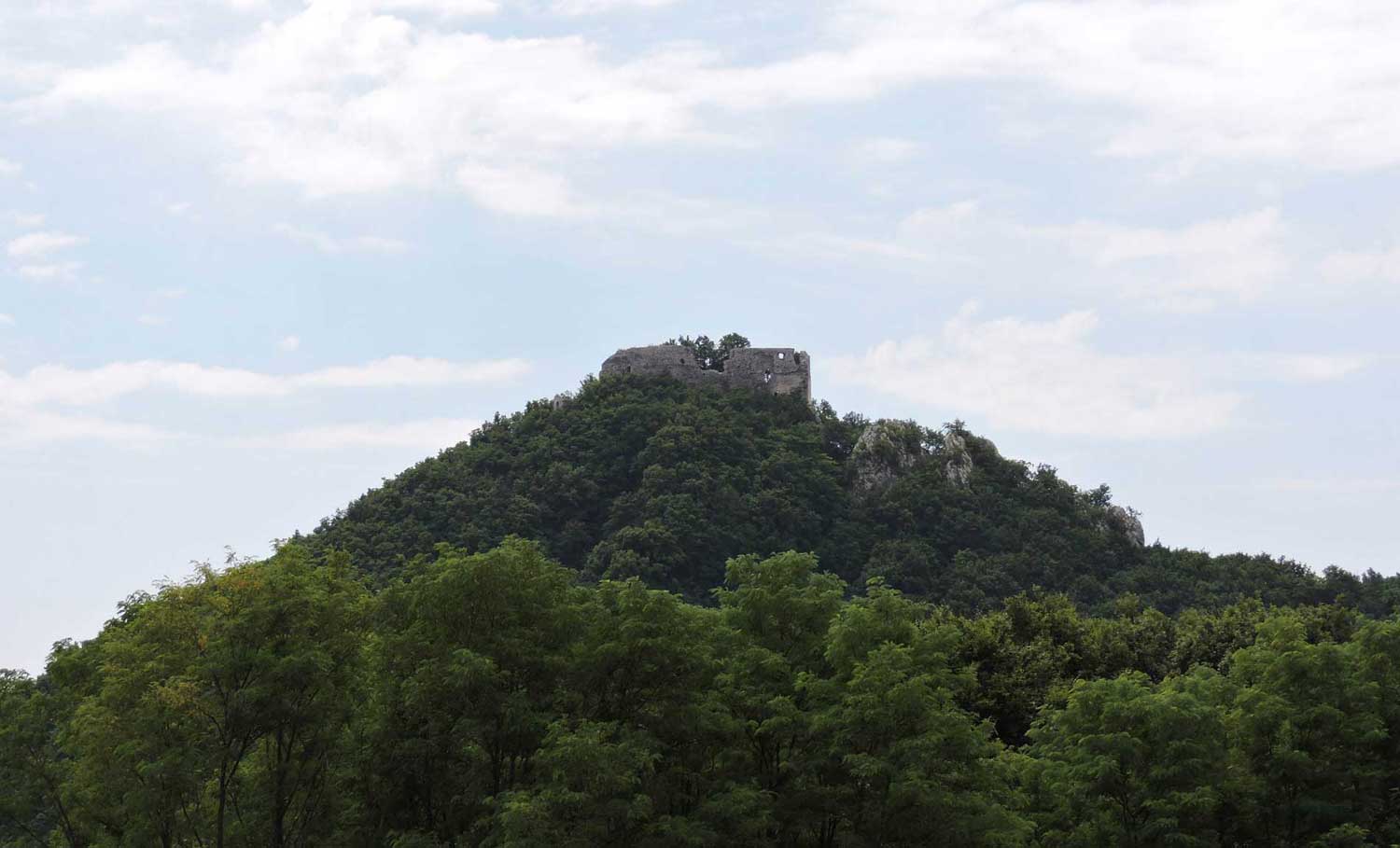
After the defeat of the Ottoman–Wallachian army at Sisak and shortly afterwards at Petrinja, the Turkish threat receded, and with it the need to maintain fortresses such as Okić, which had loomed over the plain like eagles' eyries. The castle was abandoned by its long-standing lords, the counts Erdödy, who, in keeping with the times, found greater comfort in Kerestinec Castle, built near Zagreb in 1575. Apart from the castle's wardens, who remained at Okić for a time with a small garrison and the officials who collected feudal dues, no one else resided there. The last occasion on which the noble retinue visited Okić was in 1619, when Suzana Erdödy, wife of Petar, the brother of Toma, died. Although she died at Kerestinec, it was decided to bury her in the church of the Holy Trinity at the foot of Okić, and so it was done. After the funeral, Petar invited everyone to the commemorative feast at Kerestinec, from which we may conclude that Okić was already almost entirely deserted and could no longer accommodate a large number of people. Suzana Erdödy, née Stubenberg, was in all likelihood the last member of that noble family whose remains lie beneath Okić.
Since Toma Bakač Erdödy died without an heir, in 1601, with the permission of King Rudolf II, he transferred all rights to the children of his brother Petar. The Zagreb bishopric, however, refused to accept this arrangement and demanded a share of the estates, and a lengthy legal dispute ensued which was finally settled by a compromise in 1644, under which the Erdödy family undertook to leave Okić to the Church should their line die out in the male line. Since that did not come to pass, the Erdödys continued to administer the extensive Okić estate into the early 20th century. We know that in 1647 Tomaš Erdödy pledged Okić and Kerestinec to the nobleman Gašpar Orehovečki, though he soon redeemed them. The Erdödys received their last grant of title to Okić and Kerestinec from King Joseph I in 1707, but this applied only to the inhabited Kerestinec; Okić, by contrast, is said to have been entirely neglected and abandoned for good.
What remained was only the memory of a once-celebrated fortress, its rich history, and the recollection of the princes of Okić — the Babonići, the Benvenutes, the Frankopans, the Erdödys and others. The burial and the farewell to Suzana Erdödy was at the same time a farewell to Okić, whose historical moment had passed. When Stjepan Erdödy died in 1922, the family line vanished from this region, leaving behind only the ruins of Okić, the castles of Jastrebarsko and Kerestinec — the first reduced to a ruin through the neglect of successive authorities, the second having served as a prison and barracks and being fairly well preserved. From that time on, only the curious, day-trippers, hunters, outlaws, and over the past century and a half mountaineers visited the hill-fort; the last of these soon became its owners and guardians.
Okić Castle came to life again for its eight-hundredth anniversary in 1993, when the wish of the poet Božidar Kukuljević was fulfilled and "the red-white-and-blue tricolour" once again flew from its time-worn summit.