
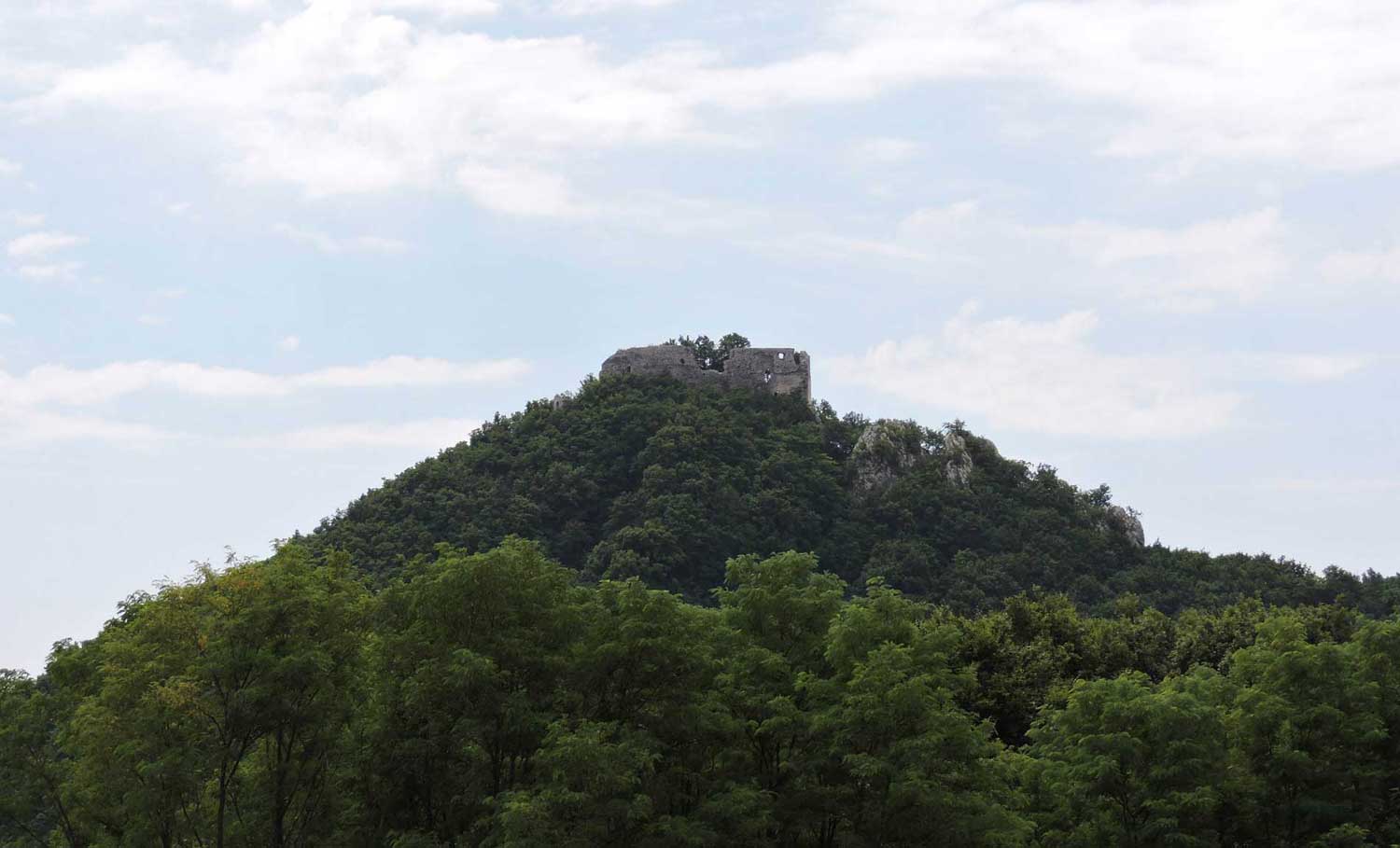
The Celts in the Okić area
Research into the prehistory of the final millennium BC in the broader Okić area has until now been wholly inadequate, and one might be forgiven for thinking that these lands were uninhabited and untouched by the main currents of historical events during the early and late Iron Age (from around 800 BC until the Romanisation of the region). Yet the most recent archaeological discoveries at Žumberak, near the village of Budinjak, show clearly how mistaken such an impression would be. There, excavations over several years have been uncovering richly furnished graves within earthen burial mounds raised beneath a prominent and powerfully fortified hilltop settlement.
More than 140 mounds have been recorded to date, many of which have been investigated. The grave goods speak of close affinities between the material and spiritual culture of the Žumberak population of the early Iron Age at Budinjak and their contemporaries in Dolenjska and Bela Krajina. Žumberak, modestly settled in our own time, was therefore inhabited during the first half of the last millennium BC by a population in which the Budinjak group played a significant role. Other such centres in Žumberak remain unknown to us, but it should be emphasised that archaeological investigation of the Žumberak area is only just beginning. The finds from Budinjak allow us to understand Žumberak as a transitional zone — a bridge between Dolenjska and the Sava–Kupa lowlands of western Croatia.
Archaeological discoveries on Grič in Zagreb, within the complex of the former Poor Clares' convent — today the Zagreb City Museum at Opatička Street 20 — where the remains of a very well-organised and prosperous Early Iron Age settlement were uncovered, add to our picture of the existence of significant centres within the broad Zagreb region, to which the Okić area belongs.
Sporadic finds, unfortunately insufficiently documented in the field, attest to habitation at other locations on the southern slopes of Medvednica, the Samobor Hills and Plešivica as well. At the settlement of Gradec below Okić, for example, fragments of Late Bronze Age pottery were collected from the surface — just as they were at Plešivica, on the slope below the parish church.
Not far from Jastrebarsko, at Gornje Malunje, graves of cremated individuals were found on two separate occasions in the late 19th century (in 1882 and 1900), accompanied by particularly striking grave goods of iron weapons. According to the testimony of the excavators, who were not professionals, the graves had been dug into a larger earthen mound, probably similar in character to those at Budinjak in Žumberak. The greater part of the finds was handed over to the Archaeological Museum in Zagreb, where they remain today, prominently displayed in the prehistoric Celtic collection. Regrettably, nothing is known of the circumstances or observations recorded during the excavation — neither the number of graves nor the associations between grave goods within individual burials.
The defining character of the Malunje find is given by well-preserved examples of Celtic iron weaponry: two swords with scabbards, bent as part of the burial ritual; two central iron bosses from large wooden shields; and five spearheads of varying form. This is superbly forged, high-quality weaponry of the kind that was the hallmark of the widely renowned Celtic tradition of iron weapon-making. The Malunje graves also yielded three iron dress-fasteners — so-called fibulae — typical of 2nd-century BC costume. One of these had once been decorated with enamel, a material highly popular among the Celts, most likely in red.
Since all subsequent investigations and searches for the location of these old finds at Malunje have proved fruitless, one must assume that only a small number of graves was involved — probably no more than two warrior burials. The Malunje find cannot therefore be taken as evidence of any prolonged presence of Celtic warriors, or of a Celtic community, in this area.
Apart from the graves of Celtic warriors at Malunje, a particularly interesting and significant find connected once again with the Celts and their presence in this region was made near Okić Castle in 1922. In the forest known as Jama, near Podgrađe, Juro Gorički of Klake discovered a hoard of silver coins buried in the ground inside a clay pot. The hoard originally comprised around 1,600 silver pieces; it was dispersed after its discovery and is today held across several museums — the Archaeological Museum and the Diocesan Museum in Zagreb, the Samobor Museum, and the National Museum in Ljubljana. The coins are all of the same type: the obverse bears the head of a man with flowing hair, a diadem and a necklace, while the reverse shows a finely rendered horse at full gallop, with no inscription of any kind.
This coin type is referred to in the scholarly literature as the "Samobor type" of Celtic coinage and is grouped alongside other distinctive Celtic coin issues. The "Samobor coins" found near Okić were struck in silver of rather poor quality, with a high proportion of copper and some lead in the alloy. The coins could not have circulated for long — their excellent state of preservation, with no signs of wear, attests to this. It is generally held that Celtic craftsmen struck coins of the "Samobor type" somewhere in the broader Samobor and Okić area, and that this substantial treasure was most probably concealed in the ground during the first half of the last century before Christ.
After discovering that clay pot containing around 1,600 pieces of darkened old coins struck in debased silver, Juro Gorički of Klake — an uneducated and illiterate man — began selling the coins to hikers passing through Okić, which eventually came to the attention of numismatists and archaeologists in Zagreb. The Archaeological Museum then informed the police, who tracked down Gorički and confiscated more than half of the coins, while the remainder "disappeared" among the hikers to whom he had been selling them.
Scholars attribute these coins to the Illyrian tribe of the Iapodes, who inhabited this area in the 2nd and 1st centuries BC, a fact further confirmed by the surviving trace of their name in Japetić, the highest peak in the Samobor Hills.