
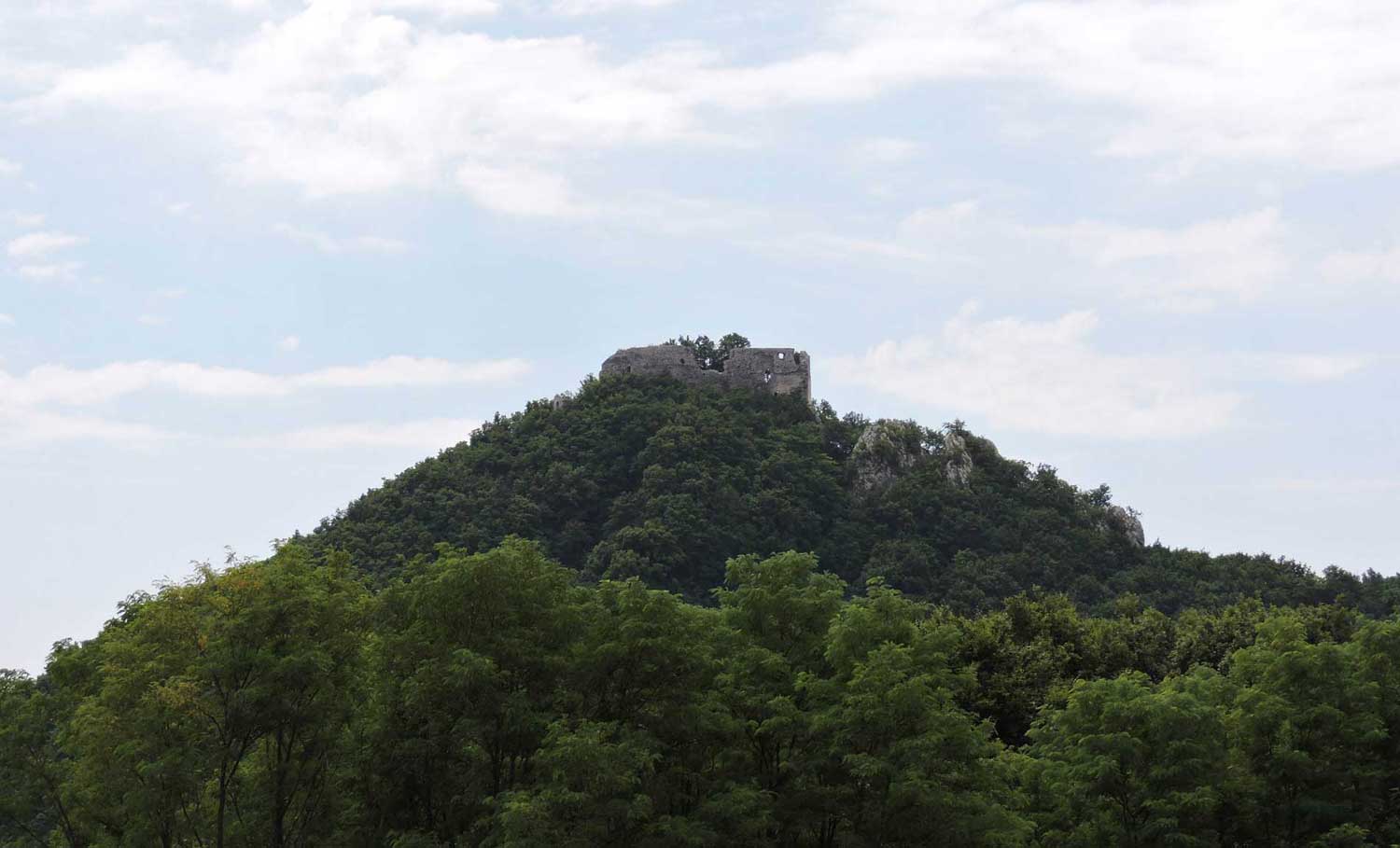
Wildlife of the Okić area
Among the animals that frequent the rocky walls of Okić, wall lizards (*Podarcis muralis*) and the venomous nose-horned viper (*Vipera ammodytes*), recognisable by the small horn on the tip of its snout, can be seen scrambling across the stones, while the harmless green lizard (*Lacerta viridis*) and the Aesculapian snake (*Elaphe longissima*), the longest snake in the area, are more commonly encountered. On the rocks one may also find the round-mouthed snail (*Pomatias elegans*), a Mediterranean species that seals its shell with a small operculum during dry spells. It is difficult to establish whether the garden dormouse (*Eliomys quercinus*) still lives here — a distinctive western Mediterranean species with brown upperparts, black eye-patches, and a slender tail tipped with a black-and-white brush. This species is known to be disappearing rapidly from central Europe. Okić is occasionally visited by a pair of ravens (*Corvus corax*) that nest in the surrounding woodland. In the hornbeam forest, among numerous other songbirds, the common whitethroat (*Sylvia communis*), rock bunting (*Emberiza cia*) and linnet (*Acanthis cannabina*) may all be observed.
Among the amphibians of the sessile oak zone, the common toad (*Bufo bufo*), fire salamander (*Salamandra salamandra*) and agile frog (*Rana dalmatina*) can all be encountered, while reptiles include the slow worm (*Anguis fragilis*) and the smooth snake (*Coronella austriaca*), a harmless species that people often mistake for the adder on account of its markings. Of the small but ferocious shrews, the pygmy shrew (*Sorex minutus*) is the tiniest — a terror to all ground-dwelling creatures up to the size of a mouse, despite weighing only 3 grams.
Beneath the surface, the European mole (*Talpa europaea*) excavates a labyrinthine network of tunnels in which it hunts earthworms and the larvae of various beetles, including the cockchafer (*Melolontha melolontha*). Hedgehogs (*Erinaceus concolor*) spend their days concealed in hedgerows and scrub. In summer, the hazel dormouse (*Muscardinus avellanarius*), the smallest dormouse in Europe, builds its distinctive spherical nest in the undergrowth. The red squirrel (*Sciurus vulgaris*) is rarely seen. Among game species, pheasants (*Phasianus colchicus*), brown hares (*Lepus europaeus*), red foxes (*Vulpes vulpes*) and roe deer (*Capreolus capreolus*) are the most numerous. The badger (*Meles meles*), which often extends fox earths for its own use, and the stone marten (*Martes foina*) are less frequently taken by hunters. In former times, grey partridges (*Coturnix coturnix*) were far more plentiful in the fields.
In addition to the woodland birds common throughout our region — chaffinch (*Fringilla coelebs*), blackbird (*Turdus merula*), great tit (*Parus major*), chiffchaff (*Phylloscopus collybita*), nuthatch (*Sitta europaea*), great spotted woodpecker (*Picodes major*), jay (*Garrulus glandarius*), cuckoo (*Cuculus canorus*) and tawny owl (*Strix aluco*) — the oak and chestnut woods are home to several more characteristic species: the nightingale (*Erithacus megarhynchos*), lesser spotted woodpecker (*Picoides minor*), golden oriole (*Oriolus oriolus*), short-toed treecreeper (*Certhia brachydactyla*), and both the spotted flycatcher (*Muscicapa striata*) and the collared flycatcher (*Ficedula albicollis*). The garden warbler (*Sylvia borin*), a rarity in these parts, has been recorded in the immediate vicinity of Okić.
Along woodland edges and in meadows, the skylark (*Alauda arvensis*), red-backed shrike (*Lanius collurio*), serin (*Serinus serinus*), greenfinch (*Carduelis chloris*), goldfinch (*Carduelis carduelis*) and yellowhammer (*Emberiza citrinella*) are all present. Around houses and gardens, house and tree sparrows (*Passer domesticus* and *P. montanus*), the collared dove (*Streptopelia decaocto*), barn swallow (*Hirundo rustica*), house martin (*Delichon urbica*), black redstart (*Phoenicurus ochruros*), jackdaw (*Coleus monedula*), magpie (*Pica pica*), hooded crow (*Corvus corone cornix*) and little owl (*Athene noctua*) all make their home. The goshawk (*Accipiter gentilis*) is known to take domestic poultry, while the protected common buzzard (*Buteo buteo*) — which is frequently shot by hunters who mistake it for a goshawk — keeps numbers of field mice and voles in check. Where conifers have been planted, the coal tit (*Parus ater*) also appears.
In the numerous streams (Konšćica, Molvica, Brebernica, Okićnica, Gonjeva and others), alongside minnow (Phoxinus phoxinus), bullhead (Cottus gobio) and chub (Leuciscus cephalus), every spring at spawning time one finds lampreys — primitive vertebrates with eel-like bodies that, in place of jaws, possess a specialised sucker disc. Here, alongside the white-throated dipper (Cinclus cinclus), one can sometimes watch water shrews (Neomys fodiens and N. anomalus) diving in search of aquatic insects, while the water vole (Arvicola terrestris) is still frequently encountered. In backwaters and ponds live the European pond turtle (the so-called frog-turtle, Emys orbicularis) and the grass snake (Natrix natrix). Along the streams, grey wagtail (Motacilla cinerea) and white wagtail (M. alba) also nest, as does the hawfinch (Coccothraustes coccothraustes) in the alders.
In puddles along forest paths and tracks, the yellow-bellied toad (*Bombina variegata*) can often be heard calling in summer. When threatened, it reveals its intensely yellow underside, advertising that — like the fire salamander — its skin is packed with toxic glands. Three species of newt inhabit the waters here: the alpine newt (*Triturus alpestris*), the large Italian crested newt (*T. carnifex*), and a distinctive Illyrian subspecies of the smooth newt (*T. vulgaris meridionalis*). Alongside the woodland rodents — the yellow-necked mouse (*Apodemus flavicollis*), bank vole (*Clethrionomys glareolus*) and common shrew (*Sorex araneus*) — the eastern Alpine–western Dinaric pine vole (*Pitymys liechtensteini*) and the alpine shrew (*Sorex alpinus*) forage on the ground at dusk and through the night. The yellow-necked mouse and the bank vole are carriers of haemorrhagic fever, and the ticks that develop in the nests of these small woodland residents may also transmit Lyme disease.
In years of good beechmast, the edible dormouse (*Myoxus glis*) becomes a frequent presence, and the pine marten (*Martes martes*) is more commonly encountered in the beech forests here than elsewhere in the Okić area. In recent years there have been surprising sightings of both the Eurasian lynx (*Lynx lynx*) and the chamois (*Rupicapra rupicapra*), which occasionally wander this far from the nearby Slovenian Kočevski Rog. Among the birds characteristic of beech woodland, the blackcap (*Sylvia atricapilla*), robin (*Erithacus rubecula*), marsh tit (*Parus palustris*), common treecreeper (*Certhia familiaris*), song thrush (*Turdus philomelos*) and grey-headed woodpecker (*Picus canus*) have all been recorded here, and the hazel grouse (*Bonasia bonasia*) appears occasionally.
The lowland part of the Okić area extends between the streams of the Okićnica and Brebernica as far as the Okić Grove woodland. This is a flood-plain landscape of pedunculate oak (*Quercus robur*) and black alder (*Alnus nigra*), where a special ornithological reserve has been established on the site of the former Zwilling fish farm, now the Crna Mlaka fishponds. On the ponds, reedbeds, marshy meadows and oak woodland, between 60 and 80 pairs of ferruginous duck (*Aythya nyroca*) nest, alongside the white-tailed eagle (*Haliaeetus albicilla*) and lesser spotted eagle (*Aquila pomarina*). Crna Mlaka is one of the most important staging posts in Europe for the ferruginous duck: in spring and autumn, between 3,000 and 5,000 individuals rest here during migration!
Among the breeding species, the Eurasian bittern (*Botaurus stellaris*), little bittern (*Ixobrychus minutus*), black stork (*Ciconia nigra*), honey buzzard (*Pernis apivorus*), black kite (*Milvus migrans*), corncrake (*Crex crex*) and various reed warblers (*Acrocephalus* spp.) are all worthy of mention. The polecats (*Mustela putorius*) forage for food around the fishponds, as do the stoat (*Mustela erminea*) and wildcat (*Felis silvestris*). The otter (*Lutra lutra*), one of Europe's most endangered mammals, has also found refuge here. Red deer (*Cervus elaphus*) and wild boar (*Sus scrofa*) are more frequently seen than roe deer.
Among the rodents of the marshy woodland and reedbeds, striped field mice (*Apodemus agrarius*) are numerous, while field voles (*Microtus agrestis*) inhabit the wet meadows and tussock sedge. The rodents of these flood-plain forests form a constant reservoir of tularaemia, and nearly 20% carry leptospires that can cause serious kidney disease. Both infections pose a real risk to careless visitors who neglect basic personal hygiene when walking in these woodlands.
Alongside the fire-bellied toad (Bombina bombina), the edible frog (Rana esculenta) and the European tree frog (Hyla arborea), a particularly notable frog species also makes its home here. Every spring, around the feast of St Joseph, parts of the marshy woodland turn blue with the appearance of the moor frog (Rana arvalis wolterstorffi) — an endemic of the Pannonian Plain, especially abundant in the Pokuplje basin and the middle Sava valley. Amphibians and rodents are preyed upon by the grass snake (Natrix natrix) and the venomous adder (Vipera berus).
In the fishponds and their adjoining channels, the dice snake (Natrix tessellata) hunts for fish. The muskrat (Ondatra zibethica) is also a common sight. After dark, various bats hunt insects among the reeds and along the woodland edges; species recorded in the area to date include the grey long-eared bat (Plecotus austriacus), the noctule (Nyctalus noctula) and the greater horseshoe bat (Rhinolophus ferrumequinum). In Zwilling's wooden manor house known as "Ribogradˮ, bats have established their summer colony.