
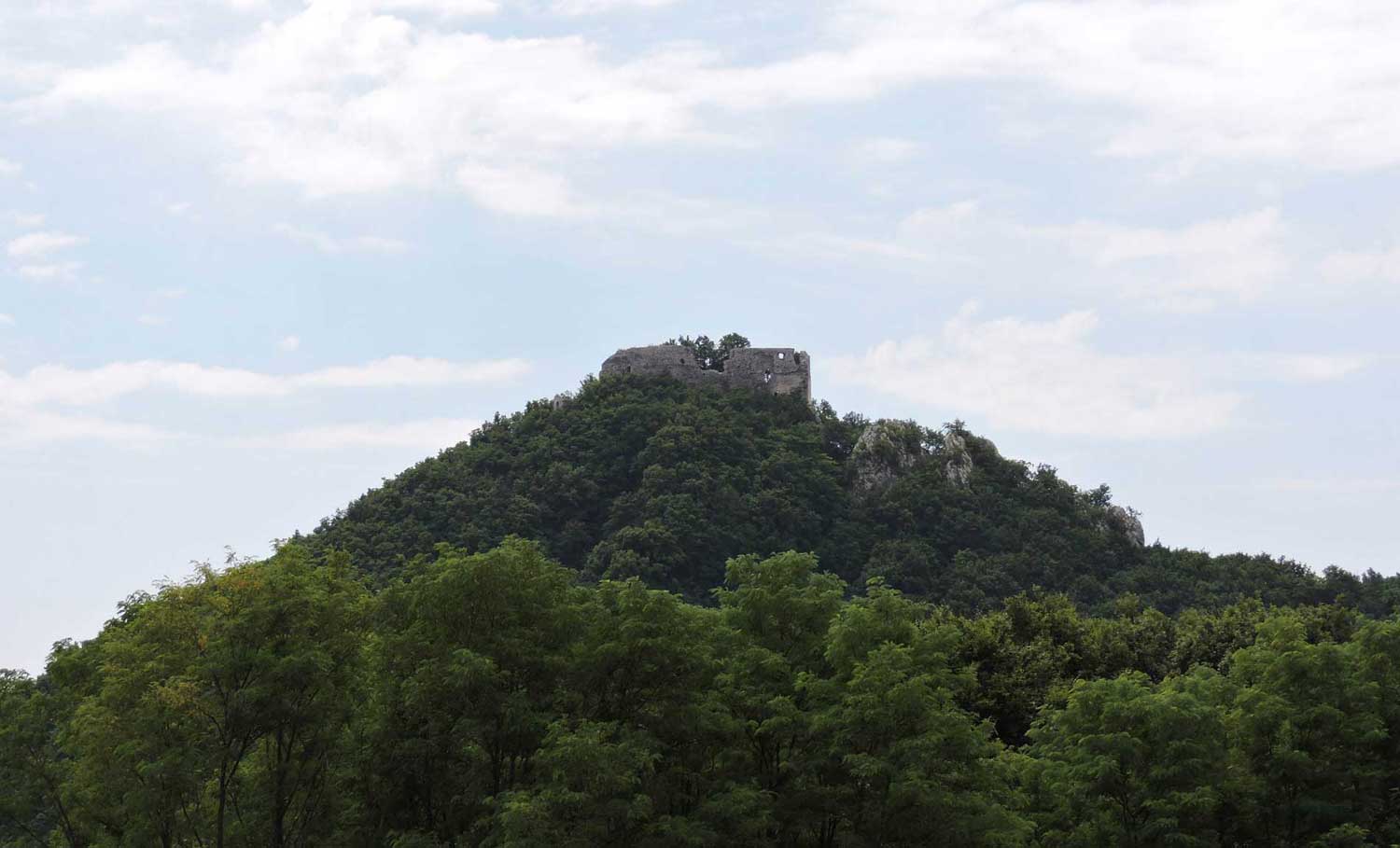
The chapel at Okić
The chapel is the smallest of the three distinct volumes that make up the architectural complex at Okić. It was built on the remaining section of an isolated rocky ridge, which determined its irregular north-east to south-west orientation. The chapel's total length of 11.50 m makes it surprisingly large for such a small noble castle; indeed, only at larger noble castles does the chapel stand as a separate building, and even there it is more commonly housed within the palas, the keep, or — more often — the gatehouse, or appears merely as a small apsidal projection off one of the palas halls.
The nave, which takes the form of an irregular elongated rectangle, leads into a chancel that is slightly shallower than a semicircle. While the nave walls are 82–84 cm thick, the chancel wall is only 70 cm thick. This may explain why the nave walls survive to a greater height: the south-western wall stands 350–380 cm, and the tallest is the north-eastern wall, which preserves its gable above the chancel arch to a height of 510 cm. Owing to the steepness of the hillside, the north-western nave wall stands 690 cm high on the outside, while the semicircular chancel wall survives on the inside only to the height of a single course at its centre, and on the outside to between 160 and 300 cm.
The chapel is entered through a doorway in the south-eastern nave wall, and its interior was lit, in addition to a window in the north-eastern wall, probably by a smaller window in the semicircular apse. No trace of the original window or door surrounds has survived.
The fabric and wall thickness of Okić's chapel already suggest a Romanesque date for its construction. Setting aside the slight irregularity in the nave plan — a consequence of the difficulties in setting out a building on such steeply falling ground — the proportions of the floor plan prove remarkably regular. The absence of stylistically diagnostic details that might allow a more precise dating is partly compensated by the internal logic of these proportions, which point to the chapel having been built at the very close of the Romanesque period, before the Mongol invasion.
More than eight full centuries have passed since the Bishop of Pécs, Kalan, dictated to his notary the decision granting the Bishop of Zagreb, Dionizije, and his successors the tithe of wine and grain "in diverses locis: Krapina, Okich et Podgorja". That decision was not prompted by any founding or building of Okić — the castle is older than that distant year of 1193 — but only future research will be able to answer just how old Okić truly is. Even so, parts of the Okić structures are already the oldest surviving remains not only among the noble castles of continental Croatia, but perhaps the oldest of their kind in this entire region, which gives them exceptional significance.
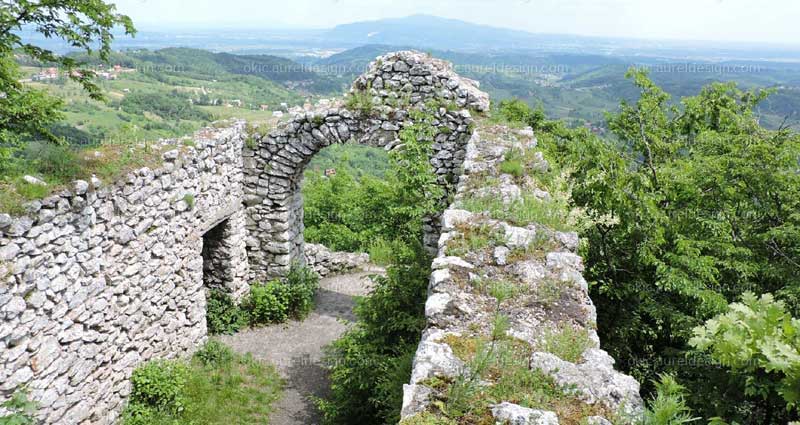
While many other castles — some considerably younger than Okić — have long since lost their battle with time, the walls of Okić display a remarkable tenacity. Neither exposure to every wind, nor the relentless advance of the forest ever seeking to reclaim what it has not yet conquered, nor human hands that demolish without understanding the worth of their ancestors' work, nor even a position on a tectonically very active fault line, has brought it down. It fights on stubbornly, losing the occasional minor skirmish when a stretch of wall partly collapses. Seeping water undermines its foundations from below; rain and snow assault it from above; frost tries to split it from within; powerful winds pressing against its walls from all sides drive seeds of woodland plants into the cracks — growing wider every day — helping those seeds to work their roots ever deeper into the solid stone and slowly crumble it. Yet despite all this, Okić still stands.
If you are willing to make the greater effort and walk around its walls on the outside, scrambling from one side to the other, you will see how close the end of this fight really is. There is no need to say who will ultimately lose. What is needed, as soon as possible, is not only a comprehensive programme of all the necessary works, but the conditions to carry out such a programme to a proper standard within a reasonable time. Until then, hawks will continue to rest undisturbed on the tops of its walls in search of their prey — with only the hope that this old Croatian noble castle, surely one of the oldest and most valuable in north-western Croatia, does not itself become the final victim.